Band 5.0 IELTS Writing Task 1 Model Answer
Overall Band Score: 5.0 · Cambridge IELTS 15 · 2026-11-10
IELTS Writing Task 1 question
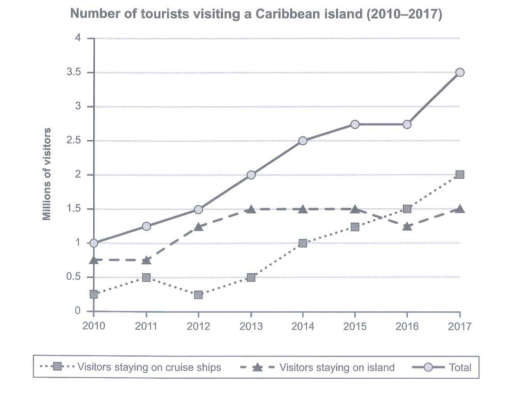
The graph below shows the number of tourists visiting a particular Caribbean island between 2010 and 2017.
Summarize the information by selecting and reporting the main features and make comparisons where relevant.
Student answer (Band 5.0)
The graph below illustrates the number of tourists visiting a carribean island from 2010 to 2017.
Overall , through the years the total of visitors had a dramatic increase ,reaching its peak at 2017 with 3.5 millions , while through this period the number of tourists who prefered to stay on the island was higher than who stayed on the cruise ships , but starting with 2015 the numbers changed for the cruise ships to take the lead.
The number of tourists who visited this caribbean island during 2010 to 2017 had such a significant increase foing from 1 millions to 3.5 in the spam of 7 years , from 2010 to 2015
the numbers of tourists kept rising significaly to reach around 2.7 millions by 2015 ,whatever through the next year the total of visitors stayed constant for it to peak again during the later year , during 2016 to 2017 the total rose to hit 3.5 millions .
The total of tourists to prefered staying on the island in 2010 surpassed the the cruise ships
AI examiner evaluation
| Criterion | Band |
|---|---|
| Task Achievement / Task Response | 5.5 |
| Coherence and Cohesion | 4.5 |
| Lexical Resource | 5.5 |
| Grammatical Range and Accuracy | 5.0 |
| Overall | 5.0 |
Task Achievement / Task Response: Band 5.5
You identify the main overall rise, report the final total of 3.5 million, and note that island-based visitors were more numerous before cruise-ship visitors took the lead. These are relevant features. However, the account is only partial: the overview says the change began in 2015, whereas cruise-ship visitors first exceeded island visitors in 2016. The body focuses heavily on the total and gives little detail about the two visitor categories; the final sentence about 2010 is incomplete and does not develop a comparison. Include the key category trends—for example, island visitors rose to about 1.5 million and then fluctuated slightly, while cruise visitors climbed to 2 million—and make the crossover year accurate.
Coherence and Cohesion: Band 4.5
The response has an identifiable overview followed by an attempt to describe the figures, so there is some organisation. However, progression is difficult to follow because the second paragraph repeats the total’s rise already stated in the overview, and the final sentence is left as an unfinished comparison. Linking expressions such as “whatever” and “for it to peak again” do not clearly show the relationships between the trends. Paragraphing also does not create a complete, balanced account of the graph. Organise the response into a concise overview and separate comparisons of the total and the two visitor groups; use clear links such as “Meanwhile,” “By contrast,” and “In 2016” only where they accurately connect the information.
Lexical Resource: Band 5.5
You use some relevant task vocabulary, including “dramatic increase,” “reaching its peak,” and “stayed constant,” and the reader can generally understand the trends you intend to describe. However, the range is limited and several noticeable spelling and word-choice errors reduce precision: “carribean,” “prefered,” “foing,” “spam,” and “significaly.” Some phrases are also unnatural, such as “the total of visitors” and “take the lead.” Use standard chart language and check spelling carefully. For example, describe the “total number of visitors,” say that cruise-ship visitors “overtook” island visitors, and use “over the seven-year period” rather than “in the spam of 7 years.”
Grammatical Range and Accuracy: Band 5.0
You attempt longer sentences with subordinate clauses, including the overview beginning “while through this period,” but these structures are often difficult to control. Errors in agreement, articles, plurals, and sentence construction appear in phrases such as “3.5 millions,” “the total of tourists to prefered staying,” and “the numbers of tourists kept rising … whatever through the next year.” The final sentence is also grammatically incomplete, and punctuation around commas is inconsistent. These problems sometimes make the intended relationships unclear. Build accuracy with shorter, complete comparisons first, then combine them using controlled clauses—for example, “The total rose to 2.75 million in 2015, remained stable in 2016, and then reached 3.5 million in 2017.”
See this exact question answered at other band scores. The same prompt compared across bands.
Browse more IELTS Writing model answers or get your own writing scored by the same AI examiner.