Band 5.0 IELTS Writing Task 1 Model Answer
Overall Band Score: 5.0 · Cambridge IELTS 15 · 2026-11-13
IELTS Writing Task 1 question
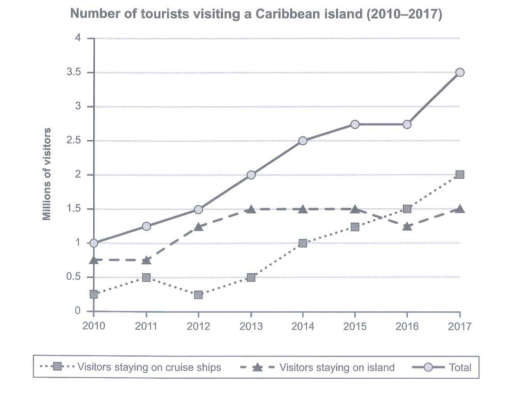
The graph below shows the number of tourists visiting a particular Caribbean island between 2010 and 2017.
Summarize the information by selecting and reporting the main features and make comparisons where relevant.
Student answer (Band 5.0)
The graph illustrates the numbers of tourists visting a particular caribbean island between 2010 and 2017.In this graph the total number of visitors had the heighest percentage in all these years.Its started from 1m to 3.5m and were the top most point of the graph.
Overall,the number of visitors staying on cruise ships stay at less than 0.5m and after that they show an upward trend,and then grew up after a slightly fell, and then they increased continously, at last there population grow to 2m in 2017.However the percentage of visitors staying on the island started from more than 0.5m and show an upward trebd from 2010 to 2013 and then they can stay at the same population in these three years,after 2015 they slightly fell and then grew up in 2015 with 1.5m
On the other hand, the total percent started from 1m in 2010 and then rose up and show a upward trend in 2015 and 2016 they remain same at 27m after that they can increased a sudden and rest at 3.5m which is the highest point.
AI examiner evaluation
| Criterion | Band |
|---|---|
| Task Achievement / Task Response | 5.0 |
| Coherence and Cohesion | 4.5 |
| Lexical Resource | 5.0 |
| Grammatical Range and Accuracy | 5.0 |
| Overall | 5.0 |
Task Achievement / Task Response: Band 5.0
You identify the overall rise in total visitors, from 1 million to 3.5 million, and note the cruise-ship figure reaching 2 million by 2017. These are relevant main features. However, several details are inaccurate or unclear: cruise-ship visitors were not consistently below 0.5 million before rising, and the total was about 2.75 million—not “27m”—in both 2015 and 2016. The island-stayer trend is also confused: it rose to 1.5 million by 2013, stayed around that level through 2015, dipped in 2016, then returned to 1.5 million in 2017; the response instead says it grew in 2015. The overview is limited and does not clearly compare the two visitor groups. Select the main trends and report them accurately.
Coherence and Cohesion: Band 4.5
The response contains relevant information and uses paragraph breaks, with an opening statement followed by trend descriptions. However, the progression is difficult to follow because several trends are combined in long, loosely connected sentences. For example, the cruise-ship account moves through “after that,” “and then,” and “at last” without clearly identifying the years or values. The island-stayer description is similarly hard to interpret, and “On the other hand” introduces the total series even though it does not present a clear contrast. Some linking phrases are repetitive or imprecise, while punctuation and spacing make boundaries unclear. Organise the report into a concise overview and separate, logically ordered descriptions of the series, using links that show the actual relationship between ideas.
Lexical Resource: Band 5.0
You use some task-relevant vocabulary, including “upward trend,” “slightly fell,” and “highest point,” so the reader can recognise the general subject and direction of change. However, the range is limited and several word choices or collocations are inaccurate, sometimes obscuring meaning. “Percentage” is used for visitor numbers, “population” for the number of tourists, and “rest at 3.5m” does not naturally describe a figure reaching that level. There are also spelling errors such as “visting,” “heighest,” “trebd,” and “continously.” Aim for precise terms such as “number,” “figure,” and “total,” and use standard trend verbs like “rose,” “remained stable,” and “recovered.” Proofreading spelling and collocation would make the report clearer.
Grammatical Range and Accuracy: Band 5.0
You attempt to connect ideas in longer sentences, for example with “after that” and “after 2015,” but control is inconsistent. Errors in verb forms and agreement occur frequently: “Its started” should be “It started,” “the number … stay” needs a past-tense verb, and “they can increased” is not a correct verb construction. Sentence boundaries and punctuation are also unreliable, as in the opening, where there is no space after “2017.” and the next sentence begins immediately. Some clauses are difficult to parse because several ideas are joined without clear grammatical structure. Use straightforward past-tense sentences first, then add controlled comparisons and subordinate clauses. Check subject–verb agreement, tense consistency, and full stops before combining ideas.
See this exact question answered at other band scores. The same prompt compared across bands.
Browse more IELTS Writing model answers or get your own writing scored by the same AI examiner.