Band 5.5 IELTS Writing Task 1 Model Answer
Overall Band Score: 5.5 · Cambridge IELTS 15 · 2026-11-13
IELTS Writing Task 1 question
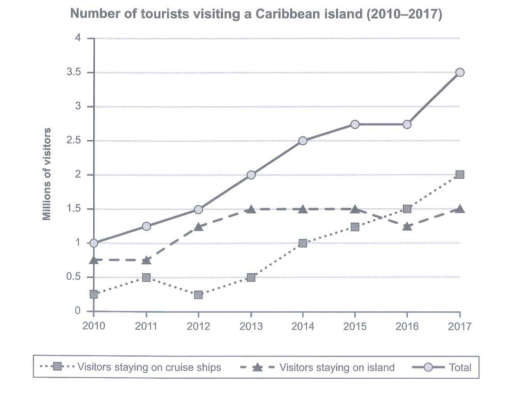
The graph below shows the number of tourists visiting a particular Caribbean island between 2010 and 2017.
Summarize the information by selecting and reporting the main features and make comparisons where relevant.
Student answer (Band 5.5)
This line graph illustrates the total number of tourists visiting a specfic caribbean island between 2010 and 2017.
In 2010, visitors staying on cruise ships had started from minimum number of visitors and than moderately increase in 2011. during this ups and down in 2017 tourists ratio increase with the passage of time and reach 2 million tourists who visiting caribbean island.
0.75 million tourists who are staying on island in 2010 and same ratio in 2011. moderately increase the number of people in 2012 who are staying on island.
the most notable increase in total number of visitors. start from one million of visitors than gradually increase the total number of visitors. In 2017 maximum number of tourists who visit the caribbean island that is 3.5 million visitors.
Overall, visitors staying on cruise ships start from 0 and reach 2 million of visitors. on the other hand number of people staying from island reach 1.5 million people in 2017. total number of visitors reach 3.5 million visitors.
AI examiner evaluation
| Criterion | Band |
|---|---|
| Task Achievement / Task Response | 6.0 |
| Coherence and Cohesion | 5.5 |
| Lexical Resource | 5.0 |
| Grammatical Range and Accuracy | 5.0 |
| Overall | 5.5 |
Task Achievement / Task Response: Band 6.0
You identify the period and report several key figures accurately: cruise-ship visitors rise to 2 million in 2017, island-staying visitors are 0.75 million in both 2010 and 2011, and the total reaches 3.5 million. The response also recognises the overall increase. However, coverage is uneven: the island-staying trend after 2012 is only briefly described, and the total series is not compared clearly with the two visitor categories. Some details are inaccurate or unclear, especially saying cruise visitors “start from 0” when the graph shows about 0.25 million, and describing their rise as occurring amid “ups and down” without specifying the fluctuations. A clearer overview and more selective, accurate comparisons would make the main features better developed.
Coherence and Cohesion: Band 5.5
The response has a basic overall arrangement, moving from cruise-ship visitors to island visitors and then total numbers, with a final summary. This gives the reader some sense of the graph’s categories. However, progression is not consistently clear: the opening cruise paragraph mixes the 2011 increase with the 2017 endpoint, and the paragraph about total visitors begins abruptly with “the most notable increase.” Linking phrases such as “on the other hand” are used, but the comparison they introduce is not fully developed. Paragraphing and clearer topic sentences would help distinguish the overview from the detailed trends. Use a more consistent sequence—overview first, then category-by-category comparisons—and connect each figure explicitly to its year.
Lexical Resource: Band 5.0
You use relevant task vocabulary, including “total number of visitors,” “cruise ships,” “increase,” and “maximum,” so the topic remains understandable. However, the range is limited and several phrases are inaccurate or unnatural, such as “tourists ratio,” “started from minimum number,” and “reach 2 million tourists who visiting.” Repetition of “number of visitors” and “reach” also makes the report less precise. Spelling and capitalization errors, including “specfic” and repeated lowercase “caribbean,” further reduce control. Build a small set of accurate trend expressions and use them consistently, for example “rose to,” “remained stable,” and “fluctuated,” while choosing “number” rather than “ratio” for visitor totals.
Grammatical Range and Accuracy: Band 5.0
The response attempts both simple statements and longer sentences, and the intended meaning is generally recoverable. However, control is inconsistent, particularly in verb forms and sentence construction. For example, “had started from minimum number … and than moderately increase” combines an unsuitable tense with an incorrect verb form, while “tourists who visiting” lacks the required auxiliary. Several fragments also appear, including “the most notable increase in total number of visitors” and “In 2017 maximum number of tourists…,” which need complete clauses. Articles, prepositions, and punctuation are also unreliable in phrases such as “staying from island.” Practise complete subject–verb sentences and use past-tense forms consistently when describing the 2010–2017 data.
See this exact question answered at other band scores. The same prompt compared across bands.
Browse more IELTS Writing model answers or get your own writing scored by the same AI examiner.