Band 6.5 IELTS Writing Task 1 Model Answer
Overall Band Score: 6.5 · Cambridge IELTS 15 · 2026-11-14
IELTS Writing Task 1 question
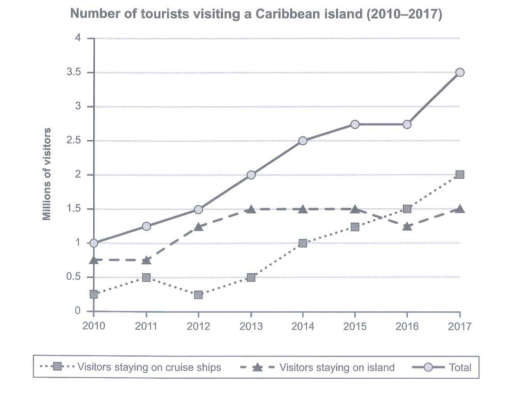
The graph below shows the number of tourists visiting a particular Caribbean island between 2010 and 2017.
Summarize the information by selecting and reporting the main features and make comparisons where relevant.
Student answer (Band 6.5)
The line graph illustrates the number of visitors staying on caribbean island, cruise ships and their total quantity over a period of seven years from 2010 to 2017.
Overall, the graph shows an upward trend in all the three cases with slight fluctuations. In case of visitors staying on cruise there is a slight decrease from 2011 to 2012, as compared to those staying on island where the number of visitors remained the same from 2013 till 2017 with a slight decrease in 2016.
The number of tourists on cruise ships increased from approximately 0.25 millions to 2 millions with an upward trend, except in 2012 which decreased to 0.25 from 0.5. In similar way, visitors who stayed on island show an increasing trend from 0.75 millions to 1.5 millions, with mostly a flat curve from 2013 to 2017, except 2016, where it fell down to 1.25 millions. Finally, the total number of visitors on island increased from 1 million to 3.5 millions, with a maximum increment from 2016 to 2017.
AI examiner evaluation
| Criterion | Band |
|---|---|
| Task Achievement / Task Response | 7.0 |
| Coherence and Cohesion | 6.5 |
| Lexical Resource | 6.0 |
| Grammatical Range and Accuracy | 6.0 |
| Overall | 6.5 |
Task Achievement / Task Response: Band 7.0
The response covers the main features and gives a clear overview: all three series rise overall, cruise-ship visitors dip in 2012, and island-staying visitors are broadly stable in the later years. The figures cited are consistent with the graph, including the increase in the total from 1 million to 3.5 million and the particularly large final rise. This selection and reporting of relevant trends is effective. To make the account more fully developed, compare the series more explicitly—for example, note that island visitors outnumbered cruise visitors until 2016, when cruise numbers became higher, and that the total was unchanged between 2015 and 2016. The overview’s claim of slight fluctuations in all three series is also somewhat broad, since the total does not fluctuate.
Coherence and Cohesion: Band 6.5
The response has a clear overall structure: an introduction, an overview, and a paragraph reporting the figures for each category. Its progression from general trends to specific data is easy to follow, and linking expressions such as “Overall,” “In similar way,” and “Finally” help signal the sequence. This gives the account a coherent arrangement. However, some connections are mechanical or imprecise: “In similar way” does not clearly explain the comparison, and “Finally” introduces the total without linking it to the two component groups. The overview also combines several details in one long sentence. Grouping the figures by meaningful comparisons, and using clearer references between the categories, would make cohesion more flexible and the progression more polished.
Lexical Resource: Band 6.0
The vocabulary is adequate for describing a line graph, with relevant terms such as “upward trend,” “fluctuations,” “remained the same,” and “increased.” These choices make the main patterns understandable, and the writer attempts some variation rather than relying on one verb throughout. However, several phrases are imprecise or unnatural, including “total quantity,” “visitors staying on cruise,” and “maximum increment.” “Flat curve” is also less suitable than a phrase describing stable figures. There are occasional word-form and spelling issues, such as “caribbean” and “0.25 millions.” More accurate collocations and consistent use of terms such as “number,” “total,” and “visitors staying aboard cruise ships” would improve precision.
Grammatical Range and Accuracy: Band 6.0
The response uses a mix of simple and more complex sentence forms, including clauses introduced by “where” and “as compared to,” and the main trends remain clear. Some sentences are controlled, such as “The number of tourists on cruise ships increased from approximately 0.25 millions to 2 millions.” However, there are some errors in articles, agreement, and sentence construction. For example, “In case of visitors staying on cruise there is” needs clearer article use and a more consistent past-tense form; “visitors who stayed on island show” shifts tense; and “which decreased to 0.25” has an unclear subject. The overview sentence beginning “In case of…” is also awkwardly structured. More consistent past tense and clearer clause construction would strengthen accuracy.
See this exact question answered at other band scores. The same prompt compared across bands.
Browse more IELTS Writing model answers or get your own writing scored by the same AI examiner.