Band 6.0 IELTS Writing Task 1 Model Answer
Overall Band Score: 6.0 · Cambridge IELTS 15 · 2026-11-15
IELTS Writing Task 1 question
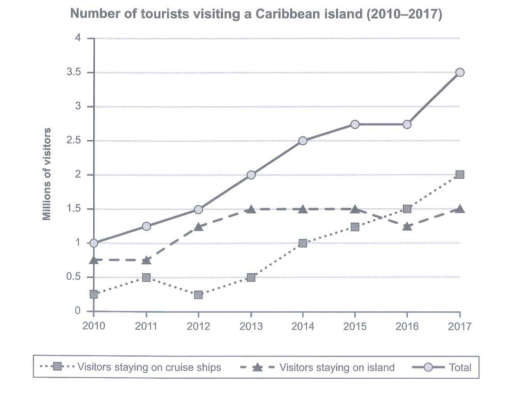
The graph below shows the number of tourists visiting a particular Caribbean island between 2010 and 2017.
Summarize the information by selecting and reporting the main features and make comparisons where relevant.
Student answer (Band 6.0)
The provied line cart illustrates the information regarding number of tourists visiting a Caribbean island from 2010 to 2017.
Overall, it is clearly noticeable that the number visitors who stayed on cruise ships are more than those who stayed on island in the year 2017. However, In 2010 there are just 0.25 million visitors who stayed on cruise ships while 0.75 million visitors was on island.
Looking at the details in more depth, number of visitors stayed on the island are almost same in year 2010 and 2011. After that, gradually more visitor started to stayed on island around 1.5 million from year 2012 to 2015. On the other hand, visitors who stayed in cruise ships there number reaches to 0.5 million in 2011, then number drops to 0.25 million in 2012 and finally the uptrend comes from 2013 to 2017 number reached at almost 2 million visitors.
In contrast, crusie ships visitors had a slow start and gradully reached to absolute top while visitors on island have a good start but ended below to crusie ships.
AI examiner evaluation
| Criterion | Band |
|---|---|
| Task Achievement / Task Response | 6.0 |
| Coherence and Cohesion | 6.5 |
| Lexical Resource | 5.5 |
| Grammatical Range and Accuracy | 5.0 |
| Overall | 6.0 |
Task Achievement / Task Response: Band 6.0
You identify the overall rise in tourism and make relevant comparisons between the two accommodation groups, including the 2010 figures and the cruise-ship total reaching about 2 million by 2017. The account of island visitors staying near 1.5 million from 2012 to 2015 is also broadly accurate. However, the overview is incomplete: it does not report the total number of visitors, which rose from about 1 million to 3.5 million, or highlight that cruise-ship visitors overtook island visitors only by the end. Some details are vague, such as “gradually more” and “absolute top,” and the final comparison repeats earlier points rather than adding a key feature. Select and summarise the main trends more precisely.
Coherence and Cohesion: Band 6.5
The response has a recognisable structure: an introduction, an overview, a paragraph describing the two visitor groups, and a concluding comparison. Its progression from the island figures to cruise-ship figures is generally easy to follow, and phrases such as “After that” and “On the other hand” help signal changes. This clear overall arrangement is a strength. However, the final paragraph largely repeats the overview, while the main detail paragraph combines both series in a way that makes comparisons less systematic. Some linking is also awkward, for example “In contrast” introduces a point already made rather than a clear contrast. Organise the body around comparable trends and use the conclusion space to report a distinct feature, especially the total trend.
Lexical Resource: Band 5.5
You use relevant vocabulary for describing a graph, including “visitors,” “reached,” “drops,” “uptrend,” and “gradually,” so the topic remains understandable. There is some variation in how you describe movement, but several choices are inaccurate or unnatural and limit precision. For example, “number visitors” omits a necessary word, “stayed on island” is an awkward phrase, and “absolute top” is not a natural way to describe a peak. Spelling errors such as “provied” and “crusie” are noticeable, while “good start” is too informal and imprecise for an academic report. Build a more reliable set of graph collocations and check spelling, word forms, and natural phrasing before submitting.
Grammatical Range and Accuracy: Band 5.0
You attempt both simple and more extended sentence forms, including a contrast with “while” and sequencing with “After that.” The main trends can usually be understood, but grammatical control is inconsistent. Examples include “the number visitors,” “the number of visitors stayed,” and “more visitor started to stayed,” where articles, verb forms, or sentence structure are faulty. Agreement is also inaccurate in “0.75 million visitors was on island,” and the sentence beginning “visitors who stayed in cruise ships there number reaches” is difficult to parse. Tense shifts between past and present also occur when describing the 2010–2017 data. Practise accurate past-tense reporting and complete clause structures, especially when combining a subject, trend verb, and figure.
See this exact question answered at other band scores. The same prompt compared across bands.
Browse more IELTS Writing model answers or get your own writing scored by the same AI examiner.