Band 6.5 IELTS Writing Task 1 Model Answer
Overall Band Score: 6.5 · Cambridge IELTS 15 · 2026-11-16
IELTS Writing Task 1 question
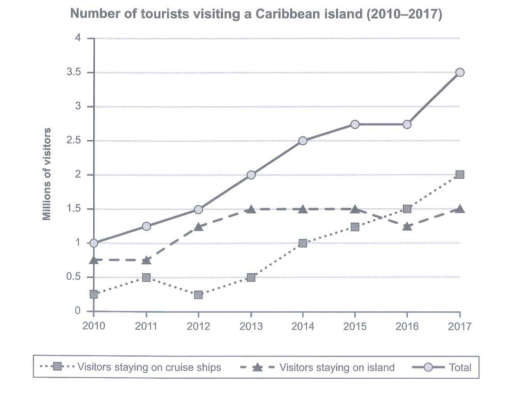
The graph below shows the number of tourists visiting a particular Caribbean island between 2010 and 2017.
Summarize the information by selecting and reporting the main features and make comparisons where relevant.
Student answer (Band 6.5)
The graph illustrates the amount of overseas visiting a Caribbean island between 2010 and 2017.
Overall, the graph depicts millions of visitors based on cruise ships and staying on island. Total amount has reached a peak of 3.5 millions in 2017, while it hit a low at 1 millions of foreigners in 2010.
The starting point of cruise members was approximately 0.3 millions in 2010, while in 2011 this amount was two times higher, in 2012 this numbers dipped at the same data as in 2010. after this year amount of cruise members rose and we saw an upward trend till 2017 when number reached 2 millions.
At the beginning, amount of internationals staying on Carribean island was equal to 0,75 millions for [redacted phone], showing increase till 2013. After this, the line levelled off and plateaud till 2015, while graph experienced downward trend. The line of cruise attandees and island stayers crossed each other in the mid of 2016 both reaching 1,25 millions of visitors. In the beginning of 2017 visitors staying on island expanded reaching same amount which it had during plateau period in amount of 1.5 millions.
Total emount of visitors experienced an uppward trend till [redacted phone], when it encountered plateau at the amount of 2.75 millions of visitors.
AI examiner evaluation
| Criterion | Band |
|---|---|
| Task Achievement / Task Response | 7.0 |
| Coherence and Cohesion | 6.5 |
| Lexical Resource | 6.0 |
| Grammatical Range and Accuracy | 5.5 |
| Overall | 6.5 |
Task Achievement / Task Response: Band 7.0
You identify the main overall pattern: total visitor numbers rise from about 1 million to 3.5 million, while cruise-ship visitors grow particularly strongly. You also report the island-stayer plateau and the later increase, so the key series are covered with relevant figures. The account is generally accurate, but the overview could compare the two visitor groups more explicitly—for example, island stays were higher for most of the period, whereas cruise visitors overtook them by 2017. The claim that the lines crossed “in the mid of 2016” is not supported: in 2016 cruise visitors are about 1.5 million and island visitors about 1.25 million, so the crossover occurred between 2015 and 2016. A clearer overview and more precise timing would make the reporting more fully developed.
Coherence and Cohesion: Band 6.5
The response has a clear paragraph structure, moving from an introduction and overview to the two visitor categories and then the total. Time markers such as “At the beginning,” “After this,” and “In the beginning of 2017” help the reader follow the sequence, and the information is mostly presented in a logical order. However, some links are mechanical or unclear. In “After this year amount of cruise members rose,” the reference to the year is vague, and the sentence about the lines crossing interrupts the account of island visitors. The final paragraph repeats the total trend already mentioned in the overview without adding much comparison. Grouping the two categories by their contrasting trends, then summarising the total once, would create smoother progression and more controlled cohesion.
Lexical Resource: Band 6.0
You use a reasonable range of trend vocabulary, including “dipped,” “upward trend,” “levelled off,” “plateaued,” and “expanded,” which allows you to describe changes rather than simply list figures. Some less suitable choices and collocations reduce precision: “cruise members” and “cruise attendees” do not naturally describe tourists, while “amount of internationals” is awkward for a count of people. There are also spelling errors in “Carribean,” “attandees,” “emount,” and “uppward.” These do not prevent understanding, but they make the report less polished. Prefer consistent, accurate terms such as “cruise-ship visitors” and “tourists staying on the island,” and check spelling carefully.
Grammatical Range and Accuracy: Band 5.5
You attempt a mix of simple and more complex sentences, including clauses linked with “while” and “when,” and the main trends are generally understandable. However, grammatical control is uneven, particularly in articles, plurals, agreement, and sentence boundaries. For example, “Total amount has reached a peak” needs an article, and “this numbers dipped” has a singular/plural mismatch. The sentence beginning “after this year” starts with a lowercase letter after a full stop, while “in 2017 when number reached” lacks an article. Some constructions are also awkwardly formed, as in “same amount which it had during plateau period.” Review article use and agreement, and punctuate each complete sentence carefully; this will make your varied structures more accurate and easier to read.
See this exact question answered at other band scores. The same prompt compared across bands.
Browse more IELTS Writing model answers or get your own writing scored by the same AI examiner.