Band 6.5 IELTS Writing Task 1 Model Answer
Overall Band Score: 6.5 · Cambridge IELTS 15 · 2026-11-19
IELTS Writing Task 1 question
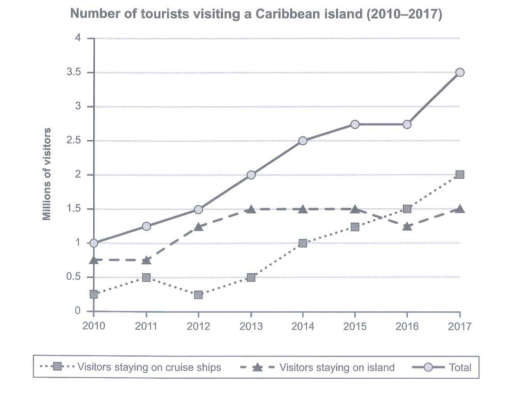
The graph below shows the number of tourists visiting a particular Caribbean island between 2010 and 2017.
Summarize the information by selecting and reporting the main features and make comparisons where relevant.
Student answer (Band 6.5)
The line chart illustrates the number of visitors visiting a specific Caribbean island across seven years ([redacted phone]).
Overall, total number of tourists increased substantially over the years. People choosing to stay either on cruise ships or on island, both of them grew gradually.
In 2010, roughly 0.25 million visitors preferred to stay on cruise ships. After a year, it doubled but the following year, it again declined to initial number. From 2013 to 2017, it showed a prominent growth and reached to a staggering 2 million of visitors spending time on cruise ships surpassing that of staying on island.
More people liked to spend time on island than cruise ships in 2010 covering neraly 0.75 million of tourists. The number stayed stable for the next year and doubled down in next two years reaching to 1.5 million visitors in 2013. Then it stayed stagnant over the years.
In these periods, people whether choose to stay on ships or island, the total number tourists visiting the island sky rocketed and more than trippled from 1 million to 3.5 million in just 7years.
AI examiner evaluation
| Criterion | Band |
|---|---|
| Task Achievement / Task Response | 7.0 |
| Coherence and Cohesion | 6.5 |
| Lexical Resource | 6.0 |
| Grammatical Range and Accuracy | 5.5 |
| Overall | 6.5 |
Task Achievement / Task Response: Band 7.0
You cover the main features and provide a clear overview: total visitor numbers rose substantially, while both accommodation categories increased overall. The account is supported with relevant figures, including the cruise-ship rise to 2 million in 2017 and the total increase from 1 million to 3.5 million. You also identify the point at which cruise-ship visitors outnumbered those staying on the island. Some details are less precise: the island figure did not double between 2011 and 2013, but rose from 0.75 to 1.5 million, and it was stable from 2013 to 2015 before dipping in 2016 and recovering in 2017. Reporting these fluctuations would make the account more fully supported and avoid over-generalising the later trend.
Coherence and Cohesion: Band 6.5
The response has a clear overall structure, moving from an introduction and overview to separate descriptions of cruise-ship and island visitors, followed by a total-figure summary. Time markers such as “After a year,” “From 2013 to 2017,” and “Then” help readers follow the sequence. This is a coherent arrangement, but some connections are mechanical or unclear. For example, “In these periods” does not clearly refer to a particular span, and the final sentence repeats the overall increase rather than adding a distinct comparison. The overview also combines both accommodation trends in a broad statement, while the body later gives more detail. Use clearer references and make each paragraph contribute a separate stage of the comparison to strengthen progression.
Lexical Resource: Band 6.0
You use an adequate range of vocabulary for describing trends, including “doubled,” “declined,” “stable,” and “stagnant,” and the meaning is generally clear. There are also attempts at more emphatic language, such as “prominent growth” and “sky rocketed,” though these are not always natural or suitably formal for an academic report. Some word choices and collocations are inaccurate, including “doubled down” for a numerical increase and “reached to” before a figure. Spelling errors such as “neraly” and “trippled” also reduce accuracy. Aim for precise, neutral trend language and check spelling; this will make the vocabulary more controlled without requiring unnecessarily elaborate expressions.
Grammatical Range and Accuracy: Band 5.5
You attempt both simple and more complex sentence forms, and the time sequence is usually understandable. However, some grammatical errors remain across the response. For example, “total number of tourists” needs an article, while “People choosing to stay … both of them grew” has an unclear and faulty subject construction. In “More people liked to spend time on island,” the article is missing, and “the total number tourists” needs “of.” The final sentence also shifts awkwardly between “whether choose” and “the total number.” These issues do not prevent the reader from understanding the main trends, but they limit accuracy. Practise building sentences around a clear subject and verb, and check articles, agreement, and complete clause structure.
See this exact question answered at other band scores. The same prompt compared across bands.
Browse more IELTS Writing model answers or get your own writing scored by the same AI examiner.