Band 5.0 IELTS Writing Task 1 Model Answer
Overall Band Score: 5.0 · Cambridge IELTS 15 · 2026-11-20
IELTS Writing Task 1 question
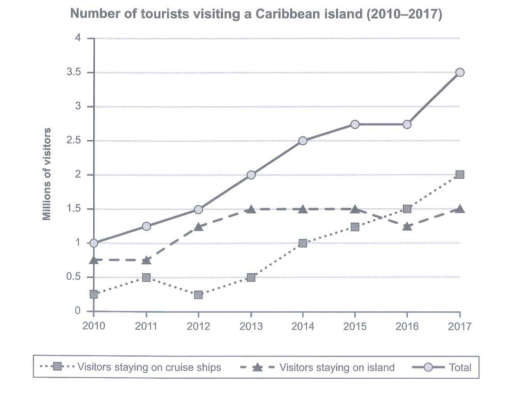
The graph below shows the number of tourists visiting a particular Caribbean island between 2010 and 2017.
Summarize the information by selecting and reporting the main features and make comparisons where relevant.
Student answer (Band 5.0)
In 2010 only 250k visitors who stayed at cruise ship visit the caribean island number of visitors slightly increas in 2011 and then decrease in 2012 and after that time number of visitor gradually increase because people show interest staying at cruise ship in caribean island. In 2010 around about 750k people who prefer to stay on island. That number was constant in 2011 after that number of visitors increase about 1.5 million till 2015 and then suddenly decearse 2016 due to some reasons. Moerover, the visitors show thw interest staying on island in 2017. There were total 1 million people who visit the Caribean island in 2010 and that number is gradually increase from 2010 to onward 2017. In 2017 there were 3.5 million people who shows interest to visit the Caribean island. 2 million vistors were thoes who prefer to staying on cruise ship and 1.5 million were thoes who shows interest to stay on island.
AI examiner evaluation
| Criterion | Band |
|---|---|
| Task Achievement / Task Response | 5.5 |
| Coherence and Cohesion | 4.0 |
| Lexical Resource | 5.0 |
| Grammatical Range and Accuracy | 5.0 |
| Overall | 5.0 |
Task Achievement / Task Response: Band 5.5
You report several key figures accurately, including the cruise-ship total of 250,000 in 2010, the island-staying figure of about 750,000, and the overall rise to 3.5 million by 2017. However, the response does not give a clear overview of the main pattern, such as the steady growth in total visitors and the contrasting, more stable trend for people staying on the island. Some details are inaccurate or unclear: cruise-ship visitors fell in 2012 rather than simply increasing, and island visitors reached about 1.5 million by 2013, remained there through 2015, dipped in 2016, then recovered in 2017. Avoid attributing changes to “some reasons” or visitor interest, as the graph does not explain causes. Select and compare the main trends more systematically.
Coherence and Cohesion: Band 4.0
The response follows a broadly understandable sequence, moving from cruise-ship visitors to island visitors and then the total. However, it is presented as one long paragraph, so the main overview and supporting details are not clearly separated. Several ideas run together, particularly the opening sentence, which combines the 2010 figure, changes in later years, and a suggested cause. Linking expressions such as “after that,” “moreover,” and “then” are used, but they do not always make the relationships between points clear, and “moreover” introduces an unclear statement rather than a distinct supporting point. Organise the report into a brief overview followed by grouped comparisons, and use precise links to show contrast and sequence.
Lexical Resource: Band 5.0
You use some relevant vocabulary for describing the graph, including “visitors,” “constant,” “increase,” and “decrease,” so the basic subject is clear. However, the range is limited and several expressions are repetitive or imprecise, such as repeated references to people who “show interest” in visiting or staying. This wording also introduces an unsupported explanation rather than neutrally describing the data. There are noticeable spelling errors, including “caribean,” “Moerover,” “decearse,” and “vistors,” which reduce clarity. Aim for accurate, task-specific terms such as “visitor numbers,” “rose,” “remained stable,” and “fell,” and check spelling and collocations carefully.
Grammatical Range and Accuracy: Band 5.0
The response attempts to connect ideas in longer sentences, but the range of sentence structures is limited and errors are frequent. For example, “number of visitors slightly increas in 2011 and then decrease” has problems with articles, verb forms, and tense consistency. In “that number is gradually increase,” the verb construction is incorrect, while “people who shows interest” has a subject–verb agreement error. Articles and plural forms are also often missing or inconsistent, as in “stayed at cruise ship” and “number of visitor.” These errors sometimes make the timeline and relationships harder to follow. Practise writing clear past-tense sentences with accurate subject–verb agreement, articles, and plural nouns before combining them into longer structures.
See this exact question answered at other band scores. The same prompt compared across bands.
Browse more IELTS Writing model answers or get your own writing scored by the same AI examiner.