Band 5.5 IELTS Writing Task 1 Model Answer
Overall Band Score: 5.5 · Cambridge IELTS 15 · 2026-11-20
IELTS Writing Task 1 question
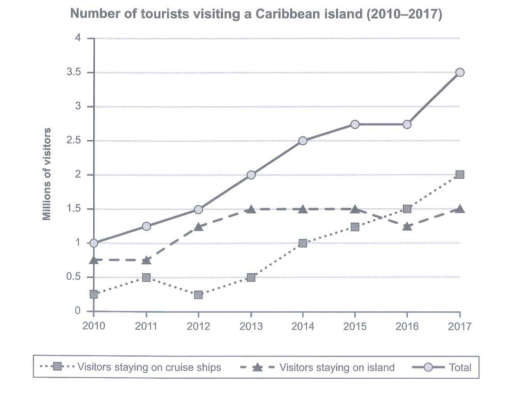
The graph below shows the number of tourists visiting a particular Caribbean island between 2010 and 2017.
Summarize the information by selecting and reporting the main features and make comparisons where relevant.
Student answer (Band 5.5)
The graph illustrates the number of tourist that visits especially the Caribbean island between the year 2010 and 2017
The total number of tourists visiting increased till 2017. The visitors count in 2010 is 1 million but on the year of 2017 it reaches to the 3.5 million. A huge increase in the tourists.
In 2012 number of visitors staying on cruise ship decreased to 0.2 million as compares to year 2011 but after that it grows up til 2017 and reaches 2 million.
There is no noticeable difference between number of visitors staying on the island 2010 to 2017. It increases from 0.7 million to 1.5 million.
End result is that there is not a noticeable difference seen in the number of visitors stays on island. But overall scanning illustrates that total number of visitors increased between the years. There is also a noticeable difference between the visitors staying on the cruise ships.
AI examiner evaluation
| Criterion | Band |
|---|---|
| Task Achievement / Task Response | 5.5 |
| Coherence and Cohesion | 5.5 |
| Lexical Resource | 5.0 |
| Grammatical Range and Accuracy | 5.0 |
| Overall | 5.5 |
Task Achievement / Task Response: Band 5.5
You identify the overall rise in total visitors, from 1 million in 2010 to 3.5 million in 2017, and note that cruise-ship visitors grew substantially by the end. These are relevant main features. However, the account is only partly complete: the claim that island-staying visitors show “no noticeable difference” overlooks their rise from about 0.75 million to 1.5 million, with a peak of 1.5 million across several years. The cruise-ship figure also did not simply decrease in 2012; it fell from about 0.5 million to 0.25 million, after which it generally rose. Include a concise overview comparing the two categories and report the key stages more accurately to make the summary fuller and clearer.
Coherence and Cohesion: Band 5.5
The response has a recognisable sequence: it begins with the total, then discusses cruise-ship and island visitors, and ends with a general conclusion. This gives the reader some organisation. However, the progression is weakened by repetition: the final two sentences repeat the claim that island visitors changed little and that the total increased. The opening is also not clearly separated as an overview, and the paragraphing does not distinguish the main trends. Linking phrases such as “but after that” help show sequence, but “End result is that” is awkward and the references in “There is also a noticeable difference” are vague. Group the overview and detailed comparisons more deliberately, and use precise links between trends.
Lexical Resource: Band 5.0
You use relevant task vocabulary, including “total number,” “visitors staying on the island,” “cruise ship,” and “increased.” This is enough to communicate the broad subject, but the range is limited and several choices or combinations sound unnatural, which makes the report less precise. For example, “tourist that visits” is an awkward way to describe the figures, “grows up” does not fit a data trend, and “overall scanning” is not an appropriate expression for summarising a graph. Repeated use of “noticeable difference” also obscures whether a figure rose, fell, or remained stable. Build a small range of accurate trend language, such as “rose steadily,” “remained stable,” and “accounted for,” and check collocations.
Grammatical Range and Accuracy: Band 5.0
The response communicates its main points, but grammatical control is inconsistent and sentence structures are mostly simple. Errors include subject–verb agreement in “the number of tourist that visits,” tense and article problems in “The visitors count in 2010 is 1 million,” and the incomplete sentence “A huge increase in the tourists.” The phrase “as compares to year 2011” also shows difficulty forming comparisons, while “the number of visitors stays on island” has errors in verb form and article use. Some longer sentences are attempted, but these patterns are not controlled consistently. Practise accurate past-tense reporting and comparison structures, and make sure each sentence has a complete clause with a clear subject and verb.
See this exact question answered at other band scores. The same prompt compared across bands.
Browse more IELTS Writing model answers or get your own writing scored by the same AI examiner.