Band 5.0 IELTS Writing Task 1 Model Answer
Overall Band Score: 5.0 · Cambridge IELTS 15 · 2026-11-20
IELTS Writing Task 1 question
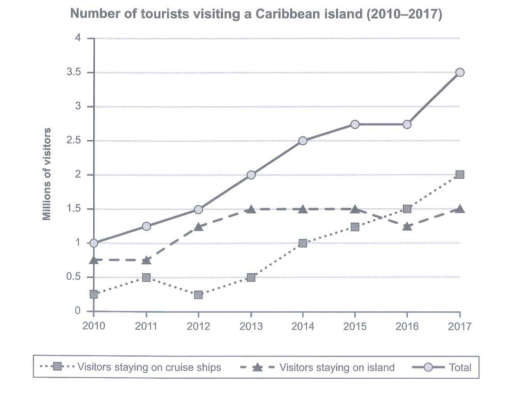
The graph below shows the number of tourists visiting a particular Caribbean island between 2010 and 2017.
Summarize the information by selecting and reporting the main features and make comparisons where relevant.
Student answer (Band 5.0)
This line graph illustrate the number of tourists who visited a particular caribbean island over the period from 2010 to 2017.
As it is shown in the graph that the visitors who stay on the cruise ships increased over the period of time . In 2010, below the half of million visitors stay on the ship while as the year passes the visitors number who stayed in the cruise ship increases.As we seen that in 2017 the number increases from 0.25 million to 2 million visitors.
While as compared to the visitors who preferred to stay on the island didn't show that much increase.In 2010 & 2011 the number of visitors who stayed on island is about 0.75 million. After that in year 2012 there is a large increased in number of visitors stayed on island and from that time the tourist numbers get stable.
At last in the conclusion , the number of tourists who stayed on the island from 2010 to 2017 are much lower than the tourists who preferred to stayed on cruise ship.
AI examiner evaluation
| Criterion | Band |
|---|---|
| Task Achievement / Task Response | 5.0 |
| Coherence and Cohesion | 5.5 |
| Lexical Resource | 5.0 |
| Grammatical Range and Accuracy | 5.0 |
| Overall | 5.0 |
Task Achievement / Task Response: Band 5.0
You identify the two visitor groups and describe several relevant trends, including the rise in cruise-ship visitors and the relatively stable island-stay figure after 2012. However, the response only partly covers the graph: it omits the total series, whose increase from about 1 million to 3.5 million is a major feature. The overview is also unclear and inaccurate in saying island visitors were “much lower” than cruise-ship visitors from 2010 to 2017; island visitors were higher in most years, with cruise visitors overtaking them only in 2017. Some figures and comparisons are imprecise, and the main features are not fully selected or summarised. Include the total trend and make the comparison accurate.
Coherence and Cohesion: Band 5.5
The response has a basic sequence: it introduces the graph, discusses cruise-ship visitors, then island visitors, and ends with a comparison. This gives the reader some organisation, and phrases such as “After that” help signal time. However, progression is weakened by repetitive and sometimes awkward linking, including “As it is shown,” “While as compared,” and “At last in the conclusion.” The final comparison does not follow clearly from the preceding details and is factually misleading. Paragraphing is limited, and several sentences run together without consistent spacing or punctuation. Group the information into a clear introduction, overview, and detail paragraphs, and use a small number of accurate transitions to show changes and comparisons.
Lexical Resource: Band 5.0
You use relevant topic vocabulary such as “visitors,” “cruise ships,” “island,” and “increased,” so the subject is generally understandable. However, the range is limited and several expressions are repetitive or imprecise, such as “the visitors number,” “large increased,” and “get stable.” Some word forms and collocations make the description less natural, while “preferred to stay” adds an unsupported suggestion about tourists’ preferences. Capitalisation and spelling also need attention, as in “caribbean.” Aim for precise chart language, including terms for totals, rises, stability, and comparisons, and check that each phrase describes what the graph shows rather than an assumed reason or preference.
Grammatical Range and Accuracy: Band 5.0
The response attempts both simple and longer sentence forms, but control is inconsistent, and errors occur frequently enough to make some sentences difficult to follow. For example, “This line graph illustrate” has subject–verb disagreement, while “the visitors who stay on the cruise ships increased” shifts tense within the description. Other problems include “in 2010 & 2011 the number … is,” “there is a large increased,” and “tourists … are much lower,” where agreement, verb form, or sentence construction is faulty. Punctuation and spacing are also inconsistent, particularly around full stops and commas. Use the past tense consistently for the period shown, check singular and plural agreement, and build shorter, complete sentences before attempting more complex comparisons.
See this exact question answered at other band scores. The same prompt compared across bands.
Browse more IELTS Writing model answers or get your own writing scored by the same AI examiner.