Band 6.0 IELTS Writing Task 1 Model Answer
Overall Band Score: 6.0 · Cambridge IELTS 15 · 2026-11-22
IELTS Writing Task 1 question
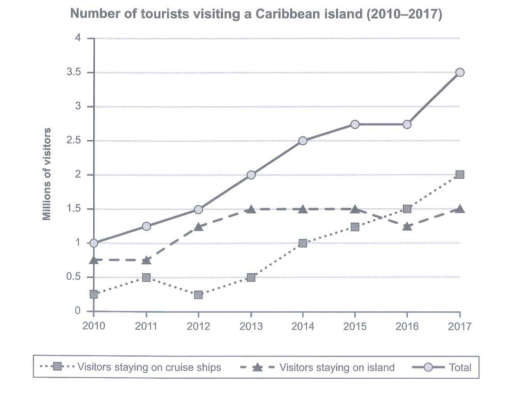
The graph below shows the number of tourists visiting a particular Caribbean island between 2010 and 2017.
Summarize the information by selecting and reporting the main features and make comparisons where relevant.
Student answer (Band 6.0)
The graph illustrates the number of tourists who visting a particular Caribbean island between 2010 and 2017. We can see an increased statement in the number of total visitors during this period.
Firstly, we will discuss visitors who staying on cruise ships, they had flactuated from the beginning in 2010 by less than a half million till 2013 by a half million. After that, these visitors number had jumped dramatically and ended in 2017 by four times compared to 2010.
Secondly, we will consider the visitors staying on island, for the first year they had remained staible by less than one milllion,meanwhile from 2011 to 2013 they had rapidly inclined to about one million and a half. The next two years, they had a stable period till 2015, while they had fluctuated in the last two years and had one and a half million by 2017.
The whole number of visitors had grown up clearly from 2010 to 2017, it started by just one million and became three and a half millions by the end.
In conclusion, there were differences in numbers between visitors who stayed on island and ones who stayed on cruise ships between 2010 and 2017.
AI examiner evaluation
| Criterion | Band |
|---|---|
| Task Achievement / Task Response | 6.5 |
| Coherence and Cohesion | 6.5 |
| Lexical Resource | 5.5 |
| Grammatical Range and Accuracy | 5.0 |
| Overall | 6.0 |
Task Achievement / Task Response: Band 6.5
You cover all three series and give a clear overall picture: total visitors rise from 1 million to 3.5 million, while cruise-ship visitors grow strongly and island stays change less. Several details are accurate, including the island figure reaching about 1.5 million in 2013 and the cruise-ship figure reaching 2 million in 2017. However, some reporting is imprecise: the cruise-ship series fluctuates only in the early years, then rises steadily, rather than simply “jumped dramatically”; and the island figure is stable from 2013 through 2015, then dips in 2016 before recovering. The comparison that cruise visitors eventually exceed island visitors would strengthen the overview. Your conclusion is relevant but repeats a general point rather than adding a precise comparison.
Coherence and Cohesion: Band 6.5
The response has a clear overall arrangement, moving from an introduction and overview to separate discussion of cruise-ship visitors, island visitors, and the total. Sequencing phrases such as “Firstly,” “Secondly,” and “In conclusion” make the structure easy to follow. This supports a coherent account, although the linking is somewhat mechanical and the final conclusion largely repeats the opening observation. Some sentence connections are awkward, particularly “The next two years, they had a stable period till 2015, while…”; clearer punctuation and a more direct transition would improve flow. You could also group the key comparisons more explicitly, showing how the two visitor categories contribute to the rising total and when cruise visitors overtake island visitors.
Lexical Resource: Band 5.5
You use relevant vocabulary for describing trends, including “fluctuated,” “remained stable,” “rapidly inclined,” and “grown.” The range is sufficient to communicate the main movements, but several word choices, collocations, and spelling errors make the description less natural and occasionally unclear. For example, “increased statement” does not express a rise, “rapidly inclined” is not a natural way to describe a graph, and “grown up clearly” is an awkward collocation. There are also misspellings such as “flactuated,” “staible,” and “milllion.” Aim for precise, conventional trend language and check spelling carefully; this will make your comparisons clearer without requiring more elaborate vocabulary.
Grammatical Range and Accuracy: Band 5.0
You attempt both simple and more complex sentences, including clauses linked with “while” and “meanwhile,” and the overall meaning is generally understandable. However, errors in verb forms, agreement, articles, and sentence construction are frequent enough to affect accuracy. Examples include “tourists who visting,” “visitors who staying,” and “they had remained” where the verb forms do not fit the sentence. The opening “Firstly, we will discuss visitors who staying…” also joins clauses with a comma rather than forming a controlled sentence. Practise using present simple to describe graph data, for example, “the number of visitors rises,” and check that each clause has a correctly formed subject and verb. More accurate basic structures would improve clarity.
See this exact question answered at other band scores. The same prompt compared across bands.
Browse more IELTS Writing model answers or get your own writing scored by the same AI examiner.