Band 5.5 IELTS Writing Task 1 Model Answer
Overall Band Score: 5.5 · Cambridge IELTS 15 · 2026-11-23
IELTS Writing Task 1 question
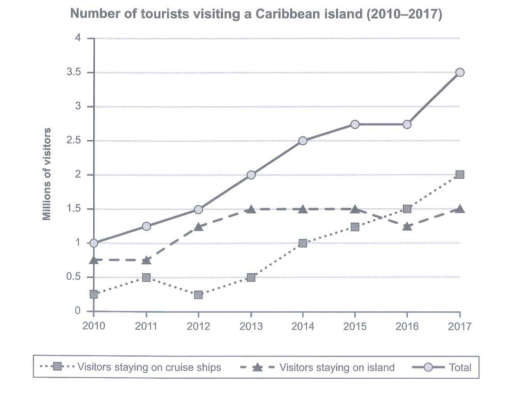
The graph below shows the number of tourists visiting a particular Caribbean island between 2010 and 2017.
Summarize the information by selecting and reporting the main features and make comparisons where relevant.
Student answer (Band 5.5)
The line graph illustrates the number of tourists who visited caribbean island from 2010 to 2017.
Overall, the total number of tourists increased over the period. While visitors who staying on cruise ships eventually outnumbered those who staying on island.
Looking into the cruise ship and total trends, the number of visiter who visited the caribbean island increased over the period which started from one million in 2010 and reached at 3.5 million in 2017. Furthermore, visitors staying on cruise ships which started in 2010 and fluctuated between 0.25 million to 0.5 million till 2013. Afterward, it increased gradually at 2 million in 2017.
Looking into the island trend, tourists who stayed on island started from 0.75 million in 2010 it increased in 2011 to 1.5 million in 2013 then levelled off till 2015
AI examiner evaluation
| Criterion | Band |
|---|---|
| Task Achievement / Task Response | 5.5 |
| Coherence and Cohesion | 5.5 |
| Lexical Resource | 5.5 |
| Grammatical Range and Accuracy | 5.5 |
| Overall | 5.5 |
Task Achievement / Task Response: Band 5.5
You identify the main overall rise in total visitors and note the important change that cruise-ship visitors eventually exceeded those staying on the island. You also include several relevant figures, such as the total reaching 3.5 million and cruise visitors reaching 2 million in 2017. However, coverage is incomplete: the island-stay figure is said to rise to 1.5 million in 2013, although it reaches 1.25 million in 2012 and 1.5 million in 2013, and the account stops at 2015 rather than describing the later decline and recovery. The response also contains only 134 words, below the required 150, which limits the detail reported. Include the full period and check each figure against the graph.
Coherence and Cohesion: Band 5.5
The response has a recognisable structure: an introduction, an overview, and separate paragraphs for cruise-ship/total figures and island stays. This helps the reader identify the main categories. However, progression within the detail paragraphs is uneven, and the final paragraph ends abruptly after “levelled off till 2015,” leaving the later years unreported. The repeated openings “Looking into…” also make the organisation feel formulaic, while “Furthermore” does not clearly signal the relationship between the total and cruise-ship trends. Use clearer chronological sequencing and connect comparisons directly—for example, explain when cruise visitors overtook island visitors—then provide a complete concluding detail paragraph.
Lexical Resource: Band 5.5
You use relevant task vocabulary, including “increased,” “fluctuated,” and “levelled off,” and the reader can generally understand the trends you intend to describe. However, the range is limited and some word choices or forms are inaccurate: “visiter” is misspelled, “caribbean” should be capitalised as “Caribbean,” and “the number of tourists who visited” is repeated where more concise alternatives would help. “Reached at 3.5 million” is also an unnatural collocation. Aim for precise chart language and vary references to the groups, such as “cruise-ship passengers” and “tourists staying on the island.” These improvements would make the report more natural and accurate without sacrificing clarity.
Grammatical Range and Accuracy: Band 5.5
You attempt both simple and more complex forms, including the contrast introduced by “While” and the time clause “which started in 2010.” However, several sentence structures are incomplete or faulty. “While visitors who staying…” is a dependent clause without a main clause, and “tourists who stayed on island started from 0.75 million in 2010 it increased…” joins two clauses without suitable punctuation or a connector. There are also errors in verb forms and agreement, such as “who staying” and “the number … increased … which started.” Use complete sentences, maintain consistent past-tense forms, and check articles and clause boundaries. More accurate control of these patterns would make the comparisons easier to follow.
See this exact question answered at other band scores. The same prompt compared across bands.
Browse more IELTS Writing model answers or get your own writing scored by the same AI examiner.