Band 4.5 IELTS Writing Task 1 Model Answer
Overall Band Score: 4.5 · Cambridge IELTS 15 · 2026-11-23
IELTS Writing Task 1 question
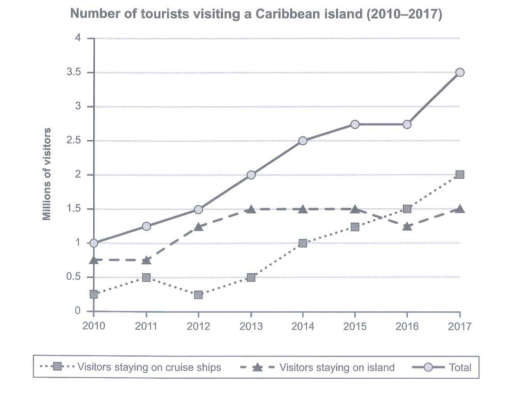
The graph below shows the number of tourists visiting a particular Caribbean island between 2010 and 2017.
Summarize the information by selecting and reporting the main features and make comparisons where relevant.
Student answer (Band 4.5)
as the graph shows there are more tourist through cruise than the island it self which shows the growth of the island is more through cruises that the island like is shown in the graph each year they has more and more tourist but also had ups and downs with the cruise and island tourist since there are more visitors staying on the cruis the economic income for the cruise compay are more that the islander because the they are not using tecnically any facility of the island which doesn't give any income to the islad just the passing money of the cruise so i my opinion they should promote more island tourism than cruisies so they can get more income they need to find a way to balance both the finance system and tourism system of there island in a way that both the sides can give them benefits
AI examiner evaluation
| Criterion | Band |
|---|---|
| Task Achievement / Task Response | 4.5 |
| Coherence and Cohesion | 4.0 |
| Lexical Resource | 5.0 |
| Grammatical Range and Accuracy | 4.5 |
| Overall | 4.5 |
Task Achievement / Task Response: Band 4.5
The response identifies a broad increase in tourism and mentions that cruise-ship visitors rise, but it does not accurately summarise the graph’s main comparisons. In particular, the claim that there are “more tourist through cruise than the island” is incorrect for most years: island-staying visitors outnumber cruise visitors until 2016, and the figures are equal only in 2017. The response also says both groups have “ups and downs,” without selecting or reporting the key changes, such as the steady rise in the total from about 1 million to 3.5 million. Instead, it shifts to opinions about cruise-company income and recommendations, which are not requested. A clearer overview and accurate supporting figures are needed.
Coherence and Cohesion: Band 4.0
There is a general attempt to connect ideas using phrases such as “as the graph shows,” “but also,” and “since,” but the response is presented as one long, largely unpunctuated sentence. This makes it difficult to distinguish the graph summary from the later opinion about island income and tourism policy. Ideas also do not progress in a clear sequence: the opening comparison is followed by a vague trend statement, then an unsupported economic claim and a recommendation. Organise the response into a brief introduction, an overview of the main trends, and a paragraph comparing the figures. Use full stops and more precise links so each point follows logically from the previous one.
Lexical Resource: Band 5.0
The response uses a small set of relevant topic words, including “tourist,” “cruise,” “island,” “growth,” and “visitors,” so the general subject is recognisable. However, vocabulary is repetitive and often imprecise, as in “more and more tourist” and “ups and downs,” which do not describe the data specifically. Several spelling errors—“cruis,” “compay,” “tecnically,” and “islad”—also make the writing less clear. Some expressions, such as “passing money of the cruise,” are difficult to interpret and are not suitable for describing a graph. Build a more accurate range for reporting trends, including terms such as “increased,” “remained stable,” and “accounted for,” and check spelling and collocations.
Grammatical Range and Accuracy: Band 4.5
The response attempts to combine ideas with clauses using “which,” “but,” and “since,” but sentence structures are not controlled consistently, and there is little accurate punctuation. For example, “as the graph shows there are more tourist through cruise than the island it self” contains problems with comparison structure, number agreement, and sentence boundaries. In “each year they has more and more tourist,” the subject and verb do not agree, and the plural form is missing. The long final sequence of clauses also makes relationships between ideas unclear. Practise writing shorter, complete sentences with accurate subject–verb agreement and plural forms, then add a few controlled complex sentences to compare trends.
See this exact question answered at other band scores. The same prompt compared across bands.
Browse more IELTS Writing model answers or get your own writing scored by the same AI examiner.