Band 5.5 IELTS Writing Task 1 Model Answer
Overall Band Score: 5.5 · Cambridge IELTS 15 · 2026-11-24
IELTS Writing Task 1 question
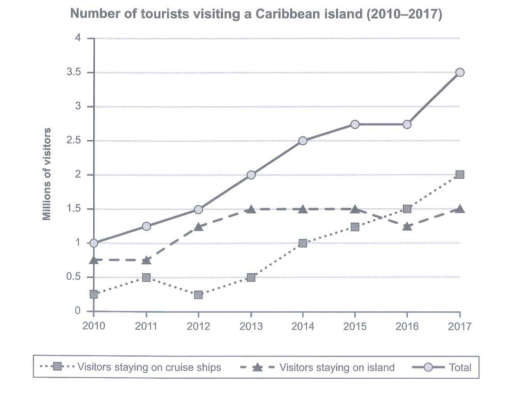
The graph below shows the number of tourists visiting a particular Caribbean island between 2010 and 2017.
Summarize the information by selecting and reporting the main features and make comparisons where relevant.
Student answer (Band 5.5)
The graph illustrates the number of visitors in Caribbean island in [redacted phone]. The number of people who visited island is given in millions.
As seen in the chart, in 2010, most of the visitors staying on the island around 0.7 million. The number will gradually increase and in 2013, it reached 1.5 million. This trend followed with some fluctuation and in 2017 the figure of total tourists who staying on island was around 1.5 million. It is seen that in 2010, the tourists were less interested in travelling by cruise ship with only 0.3 million people. In 2011, it reaches 0.5 million but after that in 2012, it shows decline and get back to 0.3 million. After 2012, the stats of visitors grown rapidly and overtake number of tourists who take stay on island between the year 2015 and 2016 and attracted the highest visitors nearly 2 million the the year 2017. The combined number of individuals was around 1 lakh and the number steadily increasing through out the period and achieved 3.5 lakh visitors on Caribbean Island.
In conclusion, in 2010, the most of the tourists were interested in staying on island as compared to who was travelling by the cruise ship but in 2017, the perspective of public was totally changed and most of the people were now travelling by the cruise ship rather than staying on island.
AI examiner evaluation
| Criterion | Band |
|---|---|
| Task Achievement / Task Response | 5.5 |
| Coherence and Cohesion | 6.0 |
| Lexical Resource | 5.0 |
| Grammatical Range and Accuracy | 5.0 |
| Overall | 5.5 |
Task Achievement / Task Response: Band 5.5
You identify the two visitor categories and report several important movements, including the rise in cruise-ship visitors to about 2 million and the total reaching 3.5 million by 2017. The comparison between island stays and cruise travel at the beginning and end is also relevant. However, some key information is unclear or inaccurate: “the combined number ... was around 1 lakh” does not match the chart’s 1 million total in 2010, and “3.5 lakh” should be 3.5 million in 2017. The overview is also weakened by describing a change in public “perspective,” which the graph does not establish. To make the summary more complete, state the overall rise in total visitors clearly and distinguish it from the trends in each category.
Coherence and Cohesion: Band 6.0
The response has a recognisable structure: an introduction, a description of the two categories, and a concluding comparison. Time markers such as “in 2010,” “after 2012,” and “in 2017” help readers follow the chronology. However, the progression is sometimes difficult to track because the account moves between categories and the total without clearly signalling each shift. The sentence beginning “After 2012” combines the cruise-ship trend, the crossover, and the peak in one long sequence. The conclusion repeats the opening comparison rather than adding a concise overview of the main trends. Use separate, clearly organised paragraphs for the overall picture and category details, and make references such as “the figure” explicit.
Lexical Resource: Band 5.0
You use relevant topic vocabulary, including “visitors,” “cruise ship,” “fluctuation,” “decline,” and “combined number,” and you attempt to describe changes rather than simply list figures. However, several word choices and collocations are inaccurate or unclear, such as “the stats of visitors grown rapidly,” “take stay on island,” and “the perspective of public was totally changed.” The use of “lakh” also conflicts with the chart’s unit of millions and makes the figures misleading. Some repetition of “number” and “visitors” limits precision. Choose standard data-reporting expressions and keep units consistent; for example, describe a figure as rising, remaining stable, or overtaking another category.
Grammatical Range and Accuracy: Band 5.0
You attempt both simple and longer sentences, and the response is generally understandable, but errors occur frequently and sometimes make relationships between ideas difficult to follow. Examples include “The number will gradually increase,” where the past-tense account requires “increased,” and “the tourists who staying on island,” which needs a correctly formed relative clause. Subject–verb agreement is also problematic in “the stats ... grown” and “it reaches.” Articles and sentence construction need attention in phrases such as “in Caribbean island” and “the most of the tourists.” Practise maintaining past tense throughout and building longer sentences around one clear main clause, checking verb forms, agreement, and articles before adding extra information.
See this exact question answered at other band scores. The same prompt compared across bands.
Browse more IELTS Writing model answers or get your own writing scored by the same AI examiner.