Band 6.0 IELTS Writing Task 1 Model Answer
Overall Band Score: 6.0 · Cambridge IELTS 15 · 2026-11-24
IELTS Writing Task 1 question
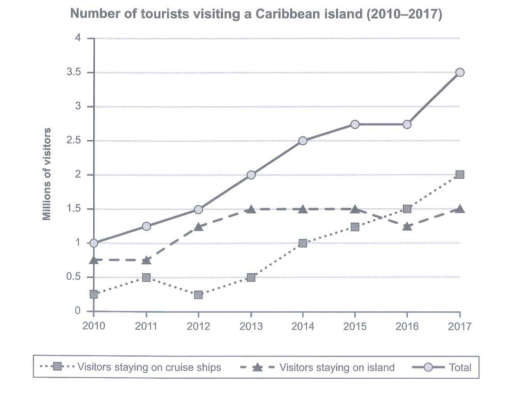
The graph below shows the number of tourists visiting a particular Caribbean island between 2010 and 2017.
Summarize the information by selecting and reporting the main features and make comparisons where relevant.
Student answer (Band 6.0)
The line graph compares the number of tourists exploring a special caribbean island from 2010 to 2017.
Overall, numbers of total visitors gradually increased throughout the period. however, tourists staying on ships also followed the same pattern as total visitors and showed a steadily increase. Moreover, visitors on island fluctuate during this time.
Regarding the graph, the tourists who staying on the cruise ships are at only [redacted phone] by 2010. It increases in the next year and reached 0.5 million. However, it declines by 2012 and reached same as 2010. In particular, it starts increasing steadily over next five years and ends at 2 million. Meanwhile, visitors who staying on the island begins with 0.8 million by 2010. It remains same in the next year but then it commences increasing until next two years and reached 1.5 million by 2013. After it remains same in next two years and then it again decrease by 2016 and reached roughly 1.3 million. Furthermore, it again rise by next year and reached 2 million.
In last, the total starts from 1 million by 2010 then it leads to increasing steadily over the next years. It reaches approximately 1.25 million by 2011 and 1.5 million by 2012. In addition, it reaches 2.5 million by 2014 and about 2.25 million by 2015. Moreover, it remains same in the next year. Hence, a sharp rise occured in 2017 and reached 3.5 million.
AI examiner evaluation
| Criterion | Band |
|---|---|
| Task Achievement / Task Response | 6.5 |
| Coherence and Cohesion | 6.5 |
| Lexical Resource | 6.0 |
| Grammatical Range and Accuracy | 5.5 |
| Overall | 6.0 |
Task Achievement / Task Response: Band 6.5
You identify the main overall rise in total visitors and distinguish between cruise-ship visitors and those staying on the island. Several key figures and trends are reported accurately, including the cruise-ship increase to 2 million and the island-stayer plateau around 1.5 million. However, some details are inaccurate: island visitors reach about 1.5 million in 2017, not 2 million, and the total is about 2.75 million in both 2015 and 2016, not 2.25 million in 2015. The overview also says cruise-ship visitors followed the same pattern as the total, although their early fluctuations differ. This covers the task, but uneven accuracy and limited comparison keep some features less fully developed.
Coherence and Cohesion: Band 6.5
The response has a clear overall structure: an introduction, an overview, and separate paragraphs describing the visitor categories and total. Time markers such as “by 2010,” “in the next year,” and “by 2017” help readers follow the sequence. However, the organisation is sometimes mechanical, with repeated transitions such as “Moreover,” “In addition,” and “Furthermore.” The final paragraph also repeats year-by-year details rather than drawing comparisons with the other categories. Some references are unclear, as in “it starts increasing steadily over next five years,” where the subject and time span could be stated more precisely. Grouping related trends and using more varied, accurate linking would make the progression smoother.
Lexical Resource: Band 6.0
You use an adequate range of vocabulary for describing a line graph, including “gradually increased,” “declines,” “remains,” and “sharp rise.” These choices generally communicate the trends, and attempts such as “commences increasing” show a willingness to vary expression. Some word choices and collocations are inaccurate or unnatural, however: “special Caribbean island” is not an appropriate description, “tourists exploring” does not match the chart’s categories, and “showed a steadily increase” uses the wrong form. “Fluctuate” is also less precise when describing the island-stayer figures, which mostly rise, level off, and then dip slightly. More conventional graph language and accurate collocations would improve precision and flexibility.
Grammatical Range and Accuracy: Band 5.5
You attempt both simple and more complex sentences, and the meaning is usually understandable. There are some recurring errors in verb forms, agreement, articles, and punctuation. For example, “the tourists who staying” needs a finite verb (“who were staying”), while “it again rise” should be “it rose again.” In “visitors on island,” an article is needed, and “numbers of total visitors” would require a clearer grammatical construction. Sentence openings after full stops are sometimes incorrectly lower-case, as in “however.” These errors do not generally prevent the reader from following the trends, but they reduce accuracy. Check subject–verb agreement and tense consistency, and proofread each sentence for complete clauses and correct punctuation.
See this exact question answered at other band scores. The same prompt compared across bands.
Browse more IELTS Writing model answers or get your own writing scored by the same AI examiner.