Band 5.5 IELTS Writing Task 1 Model Answer
Overall Band Score: 5.5 · Cambridge IELTS 15 · 2026-11-25
IELTS Writing Task 1 question
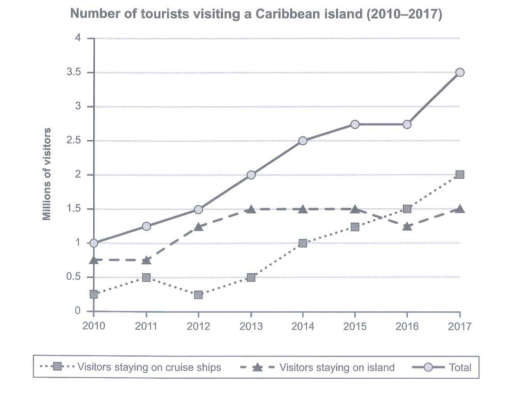
The graph below shows the number of tourists visiting a particular Caribbean island between 2010 and 2017.
Summarize the information by selecting and reporting the main features and make comparisons where relevant.
Student answer (Band 5.5)
The line graph illustrates how many visitors went to a specific Caribbean island from 2010 to 2017. The numbers are displayed in millions.
Overall, the total number of people kept rising in almost every year. Some of them preferred to stay on cruise ships and the others went to stay on island.
In 2010, 1 million tourists visited the island and around 0.7 million of them stayed on island while only 0.5 million decided to stay on cruise ships. The total number of visitors as well as those staying on ships increased the next year by almost 0.3 million but the number for people living in island stayed the same. In 2012, the total number showed a steady growth at 1.5 million (around 1.6 million living in islands and 0.3 million staying on ships). The next year all the numbers showed visible rise. In 2014, 2.5 million people in total visited the island while people staying on island were the same as last year but the more people started staying on ships . For 2015, the total number of public was almost 2.8 million which was the same till 2016 and rose to 3.5 million in 2017 which was the highest . the number of tourists living in ships also showed a steady rise during the last 4 years.
AI examiner evaluation
| Criterion | Band |
|---|---|
| Task Achievement / Task Response | 5.5 |
| Coherence and Cohesion | 6.0 |
| Lexical Resource | 5.5 |
| Grammatical Range and Accuracy | 5.5 |
| Overall | 5.5 |
Task Achievement / Task Response: Band 5.5
You identify the period and give a general overview that totals rose, with cruise-ship visitors increasing particularly towards the end. However, several figures are misreported, which weakens the accuracy of the account: in 2010, cruise-ship visitors were about 0.25 million, not 0.5 million; in 2012, island-staying visitors were about 1.25 million, not 1.6 million; and in 2011 the total rose by about 0.25 million, not 0.3 million. The overview also misses the important contrast that island-staying numbers levelled off around 1.5 million, while cruise-ship numbers climbed to 2 million by 2017. Select the main trends accurately and compare the two groups more explicitly.
Coherence and Cohesion: Band 6.0
The response has a clear basic structure: an introduction, an overview, and a chronological account of the figures. Time markers such as “In 2010,” “In 2012,” and “For 2015” help readers follow the sequence. However, the body becomes a long chain of year-by-year details, and some links between ideas are unclear. For example, “The next year all the numbers showed visible rise” does not specify which figures rose, while the final sentence adds a trend without connecting it to the preceding comparison. Organise the details into clearer groups—for example, describe the island-staying trend together and then contrast it with cruise-ship growth—and use references that make each comparison easy to follow.
Lexical Resource: Band 5.5
You use relevant vocabulary for describing a graph, including “increased,” “steady growth,” “rose,” and “highest,” so the main trends are generally understandable. However, some word choices and collocations are inaccurate or informal for this task. “People living in island” and “tourists living in ships” do not clearly describe visitors’ accommodation; “staying on the island” and “staying on cruise ships” are more natural. “The total number of public” is also an unsuitable phrase, and “visible rise” is less precise than “noticeable increase.” Repeated use of “number” and “people” limits the range. Build a small set of accurate terms such as “visitor total,” “figure,” “remained stable,” and “accounted for” to make comparisons more precise.
Grammatical Range and Accuracy: Band 5.5
You attempt a mix of simple and more complex sentences, including clauses linked with “while” and “but,” and the overall meaning can usually be followed. Some grammatical errors remain, particularly with articles, prepositions, and sentence boundaries. For instance, “stay on island” needs an article, and “living in island” is not a correct grammatical pattern; write “staying on the island.” The sentence beginning “For 2015” runs into the 2016 and 2017 information and ends with a lower-case “the,” so it needs clearer punctuation and sentence division. There is also an awkward construction in “but the more people started staying on ships.” Check articles and prepositions, and proofread long sentences by separating distinct year-by-year points.
See this exact question answered at other band scores. The same prompt compared across bands.
Browse more IELTS Writing model answers or get your own writing scored by the same AI examiner.