Band 5.5 IELTS Writing Task 1 Model Answer
Overall Band Score: 5.5 · Cambridge IELTS 15 · 2026-11-26
IELTS Writing Task 1 question
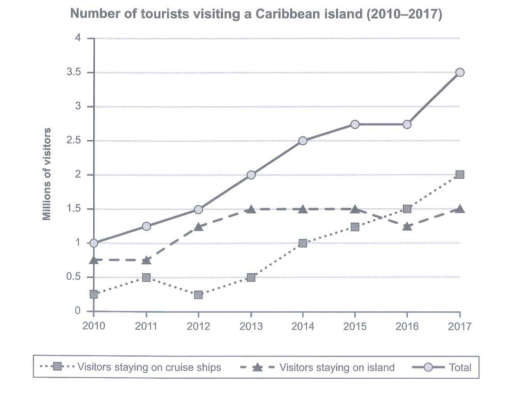
The graph below shows the number of tourists visiting a particular Caribbean island between 2010 and 2017.
Summarize the information by selecting and reporting the main features and make comparisons where relevant.
Student answer (Band 5.5)
The following line graph illustrates the number of tourists visiting a particular Caribbean island between 2010 and 2017 and their number was in millions. Moreover, there are three different lines in graph which represents the visitors staying on cruise ships, staying on island and total numbers.
Firstly, in 2010 the number of visitors staying on cruise ships was 0.3 million which is such a low number. However, the trend figures were fluctuated for one year, then in 2012 the trend were sharply increased throughout the period and in 2017 the figure was approximately 2 million.
Next, the visitors staying on island, starting with 0.7 million numbers then stable for one year, while in 2012 the numbers were gradually increased for four years but in 2016 the trend was fell down again .
If we talked about the total trend of visitors, the numbers were continously rose and in 2017 the total number of tourists was 3.5 million which was the great success for Caribbean island.
AI examiner evaluation
| Criterion | Band |
|---|---|
| Task Achievement / Task Response | 5.5 |
| Coherence and Cohesion | 6.0 |
| Lexical Resource | 5.5 |
| Grammatical Range and Accuracy | 5.0 |
| Overall | 5.5 |
Task Achievement / Task Response: Band 5.5
You identify the graph’s subject and report several relevant figures, including cruise-ship visitors rising to about 2 million in 2017, island visitors dipping in 2016, and the total reaching 3.5 million. However, the overview is not clearly separated from the details, and the main pattern is only partly explained: the total rose overall, while cruise-ship numbers grew strongly and island-based visitors changed comparatively little. The claim that cruise-ship figures fluctuated “for one year” is unclear, and the island series is described as increasing for four years despite levelling off from 2013 to 2015. A clearer overview and more accurate comparisons across the period would make the summary more complete.
Coherence and Cohesion: Band 6.0
The response has a recognisable sequence, moving from cruise-ship visitors to island visitors and then the total, and paragraph breaks help distinguish these sections. Linking expressions such as “Firstly,” “Next,” and “If we talked about” guide the reader through the categories. However, the progression within the descriptions is sometimes difficult to follow: “the trend figures were fluctuated for one year” does not clearly identify which years are being compared, and “then in 2012” leaves the timeline imprecise. Some transitions feel mechanical, while the final sentence introduces an evaluative comment rather than completing a neutral summary. Use clearer time references and connect comparisons directly to the relevant figures.
Lexical Resource: Band 5.5
You use relevant topic vocabulary, including “visitors,” “total,” “trend,” and “approximately,” so the subject remains understandable. There are also attempts to describe change with terms such as “sharply increased” and “gradually increased.” However, several word choices and collocations are inaccurate or repetitive: “the trend figures were fluctuated,” “the trend was fell down,” and “the great success” do not express graph data naturally. “Numbers” is repeated where “figure” or “visitor total” would be more precise, and “stable” could be replaced with “remained unchanged.” Aim for a small, accurate range of standard trend language and avoid interpreting a high figure as a success.
Grammatical Range and Accuracy: Band 5.0
You attempt both simple and longer sentence forms, and the reader can generally understand the main comparisons. However, errors in verb forms, agreement, and sentence construction are frequent enough to make some statements awkward or unclear. For example, “the trend figures were fluctuated” uses an incorrect passive form, while “the trend were sharply increased” has agreement and verb-form problems. In “the trend was fell down again,” the verb pattern is also faulty. The opening sentence’s “and their number was in millions” has an unclear reference, and punctuation is inconsistent, including the space before the full stop after “again .” Practise accurate past-tense forms such as “fluctuated,” “increased,” and “fell,” and build shorter, controlled sentences before combining ideas.
See this exact question answered at other band scores. The same prompt compared across bands.
Browse more IELTS Writing model answers or get your own writing scored by the same AI examiner.