Band 5.5 IELTS Writing Task 1 Model Answer
Overall Band Score: 5.5 · Cambridge IELTS 15 · 2026-11-26
IELTS Writing Task 1 question
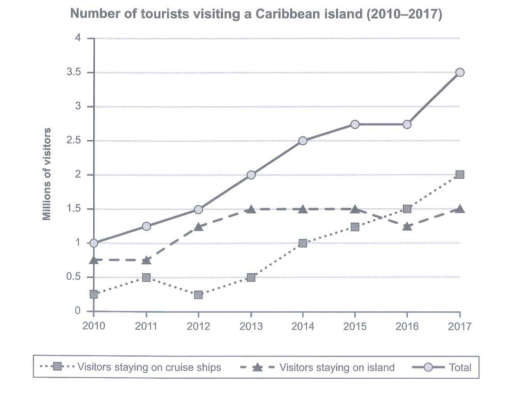
The graph below shows the number of tourists visiting a particular Caribbean island between 2010 and 2017.
Summarize the information by selecting and reporting the main features and make comparisons where relevant.
Student answer (Band 5.5)
The graph below clearly shows the number of visitors whom explored Caribbean island between years 2010 and 2017.there were two types of tourists visiting island, those who stayed on cruise ships and other type stayed on island.
to begin with, in the year 2010 cruise ships were highly common and was on the rise for a year unlike island stayers which did not changed a bit, but from 2011 cruise ships started to decrease and island stays began rising for two years while cruise ships also increasead in 2012 to 2017. during that period island froze its increase and in 2015 even lost half a million visitors. at that time cruise ships had 1.5 million visitors which rised to 2 million in 2017. in comparisons cruises gained over 2 million visitors while islanders stayed on 1.5 million. in total Carribbean island became more and more popular among tourist, welcoming 1 million to 3.5 million visitor to their home.
AI examiner evaluation
| Criterion | Band |
|---|---|
| Task Achievement / Task Response | 5.5 |
| Coherence and Cohesion | 5.5 |
| Lexical Resource | 5.5 |
| Grammatical Range and Accuracy | 5.0 |
| Overall | 5.5 |
Task Achievement / Task Response: Band 5.5
You identify the two visitor groups and give a broad overall trend: total arrivals rose from about 1 million to 3.5 million, while cruise-ship visitors increased substantially. However, several details are inaccurate or unclear. Cruise-ship numbers did not rise in 2010–11 and then decrease from 2011; they rose from 0.25 to 0.5 million, fell in 2012, and then increased. Island visitors did not lose half a million in 2015: they remained at about 1.5 million that year and dipped to 1.25 million in 2016. The overview also misses the key comparison that island stays were higher initially, whereas cruise visitors overtook them by 2016. Select the main turning points accurately and distinguish the two series more clearly.
Coherence and Cohesion: Band 5.5
The response follows a broadly chronological order and uses some linking expressions, including “to begin with,” “but,” and “in total,” so the reader can follow the general subject. However, it is presented as one long paragraph, with no clear separation between an introduction, an overview, and supporting details. Several transitions connect ideas that are difficult to reconcile, such as saying cruise visitors “started to decrease” before describing their later increase. The repeated use of “while” and “during that period” does not always make the relationships between the figures clear. Organise the report into distinct paragraphs and use links to show precise contrasts and changes, rather than relying on a sequence of loosely connected statements.
Lexical Resource: Band 5.5
You use some relevant vocabulary for describing trends, such as “on the rise,” “increase,” “froze its increase,” and “became more and more popular.” This gives you a basic range for the task, but several choices are inaccurate or unnatural and sometimes obscure the intended meaning. For example, “cruise ships were highly common” does not clearly describe visitor numbers, and “islanders” refers to local people rather than tourists staying on the island. “Lost half a million visitors” is also an imprecise way to describe a change in the series. Spelling errors such as “Carribbean” and “increasead” are noticeable. Use standard chart language such as “rose,” “remained stable,” and “declined,” and check spelling and collocations.
Grammatical Range and Accuracy: Band 5.0
You attempt longer sentences with contrast and time clauses, for example, “while island stays began rising for two years while cruise ships also increasead.” However, control is inconsistent, and errors in sentence structure, verb forms, agreement, and punctuation occur frequently enough to make some relationships difficult to follow. Examples include “visitors whom explored,” “was on the rise,” “did not changed,” and “which rised.” The opening also runs into the next sentence without appropriate spacing or capitalisation, and the final sentence has unclear agreement in “visitor to their home.” Practise forming accurate past-tense comparisons, including “visitors who explored,” “did not change,” and “which rose,” and divide long sentences into clearer units.
See this exact question answered at other band scores. The same prompt compared across bands.
Browse more IELTS Writing model answers or get your own writing scored by the same AI examiner.