Band 6.0 IELTS Writing Task 1 Model Answer
Overall Band Score: 6.0 · Cambridge IELTS 15 · 2026-11-27
IELTS Writing Task 1 question
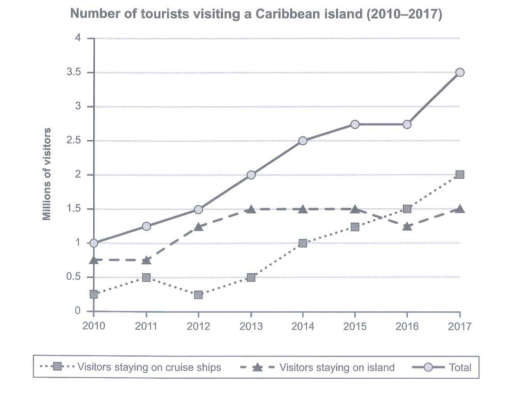
The graph below shows the number of tourists visiting a particular Caribbean island between 2010 and 2017.
Summarize the information by selecting and reporting the main features and make comparisons where relevant.
Student answer (Band 6.0)
The line graph illustrates the number of tourists (in millions) and where they have stayed while visiting a particular Caribbean island between from 2010 to 2017.
Overall, most of the visitors prefered to stay on a cruise ship, than staying on the island itself. While the total number of visitors increased significantally during this period.
The number of people visiting the Caribbean island increased from 1 million to 3.5 million over the span of 7 years.
In the year 2010, visitors perfered staying on the island as compared to staying on a cruise ship, as 0.7 million people prefered island over the ship. The number of visitors that stayed on the island kept increasing over the years, from 0.7 million to around 1.5 million, until it declined in 2016 to 1.3 million and then reached 1.5 million again in 2017. However, the number of people who prefered to stay on the cruise ship decreased in 2012, a major rise was seen from the year 2013 to 2017 with the highest number being around 2 million visitors.
AI examiner evaluation
| Criterion | Band |
|---|---|
| Task Achievement / Task Response | 6.0 |
| Coherence and Cohesion | 6.5 |
| Lexical Resource | 6.0 |
| Grammatical Range and Accuracy | 6.0 |
| Overall | 6.0 |
Task Achievement / Task Response: Band 6.0
You identify the overall rise in total visitors, from 1 million to 3.5 million, and report several relevant changes in both accommodation categories. The island-stay figures are described with a useful sequence, including the dip in 2016 and recovery in 2017. However, the overview contains a significant misreading: cruise-ship visitors did not generally outnumber island visitors; island stays were higher until 2015, and cruise visitors became the larger group only in 2016 and 2017. The overview also omits the total’s plateau at about 2.75 million in 2015–16. Some details are imprecise, such as the 2010 island figure, but the main trends are mostly covered. A more accurate overview and clearer comparisons would strengthen the response.
Coherence and Cohesion: Band 6.5
The response has a clear overall arrangement: an introduction, an overview, and paragraphs presenting the total and category details. The chronology is generally easy to follow, and linking expressions such as “Overall,” “However,” and “then” help connect information. This meets the lower-band expectation of a coherent arrangement and shows some flexibility in sequencing. However, the overview’s contrast between cruise and island stays is confusing because it reverses the main relationship for much of the period. The final sentence also joins a decline and a rise in a way that makes the comparison slightly awkward. Grouping the two accommodation trends together and using clearer contrasts—for example, “By contrast” or “Meanwhile”—would make progression more controlled and less dependent on basic sequencing.
Lexical Resource: Band 6.0
You use an adequate range of task-related vocabulary, including “increased,” “declined,” “rise,” and “highest number,” so the main information remains understandable. There are also attempts to vary expressions for visitors and accommodation. However, several word choices and collocations are imprecise: “prefered to stay … than staying” is not a natural comparison, and “a major rise was seen” is less direct than describing the figures as rising. Spelling errors such as “significantally,” “prefered,” and “perfered” also reduce accuracy. In addition, “visitors prefer” suggests a preference rather than reporting what the graph measures. Use neutral reporting language and check spelling to make the vocabulary more precise and appropriate for describing data.
Grammatical Range and Accuracy: Band 6.0
You use a mix of simple statements and longer sentences, including clauses with “while,” “as,” and “until,” and the meaning is generally clear. Some sentence forms are handled successfully, such as “The number of people visiting the Caribbean island increased from 1 million to 3.5 million.” However, some grammatical errors remain. The opening says “between from 2010 to 2017,” where only one time expression is needed. In the overview, “While the total number … increased” is a dependent clause presented as a sentence fragment. The comparison “prefered to stay … than staying” also has mismatched grammatical forms, and the final sentence combines two developments without a clear grammatical link. More accurate clause construction and parallel comparisons would improve control.
See this exact question answered at other band scores. The same prompt compared across bands.
Browse more IELTS Writing model answers or get your own writing scored by the same AI examiner.