Band 5.5 IELTS Writing Task 1 Model Answer
Overall Band Score: 5.5 · Cambridge IELTS 15 · 2026-11-28
IELTS Writing Task 1 question
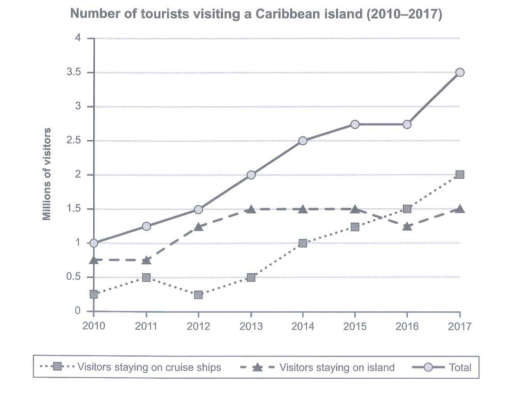
The graph below shows the number of tourists visiting a particular Caribbean island between 2010 and 2017.
Summarize the information by selecting and reporting the main features and make comparisons where relevant.
Student answer (Band 5.5)
The graph illustrates the number of tourists visiting a particular Caribbean island between the year 2010 and 2017.
Overall, it is clear that Total is the higest category from 2010 to 2017, But in 2010, Visitors staying on Crulse ships is lowest category of this graph while in 2017 it increased as comapreed to visitors staying on island.
Firstly, we describe Total in 2010, it about one million of visitors after some years in 2013 it reached 2 million. Moreover, in 2016 Total more increased this time it approximaely 4 million of visitors but in last year in 2017 it rapidly grow.
on the other hand, this graps demonstrates two other category in 2010, 0.7 million of visitors staying on island after one year it reamins same but in 2012 it some rose and in 2013 it reached nearly to 1.5 million in 2014 and 2015 it remain constant after 1 year it fell but in 2017 it again climbed. Meanswhile, in 2010, visitors staying on crulse ships about 0.3 million after 1 year it up and again in 2012 it down, but in 2016 it reached nearly to 1.5 million and in 2016 it more grown this time 2 million visitors staying on crulses ships.
AI examiner evaluation
| Criterion | Band |
|---|---|
| Task Achievement / Task Response | 5.5 |
| Coherence and Cohesion | 5.5 |
| Lexical Resource | 5.0 |
| Grammatical Range and Accuracy | 5.0 |
| Overall | 5.5 |
Task Achievement / Task Response: Band 5.5
You identify the chart’s subject and include an overview that total visitor numbers were highest, while cruise-ship visitors rose substantially by the end. You also report several relevant figures, such as the total reaching 2 million in 2013 and island-staying visitors remaining around 1.5 million in 2014–15. However, some key details are inaccurate or unclear: the total in 2016 was about 2.75 million, not nearly 4 million, and the 2017 total was 3.5 million. The cruise-ship series reached 2 million in 2017, not 2016. The overview also does not clearly summarise the overall growth in total visitors or the contrasting pattern of island-staying visitors. Select the main trends accurately and distinguish the three series more clearly.
Coherence and Cohesion: Band 5.5
The response has an opening, an overview, and separate discussion of the total and the two visitor types, so there is some organisation. Time references such as “in 2010,” “in 2013,” and “in 2017” help readers follow the chronology. However, progression is weakened by long, crowded sentences that list several years and changes without clear breaks. The paragraph beginning “on the other hand” combines both visitor categories, and the repeated “but” and “after” make relationships between points mechanical. Some references are also unclear, particularly “in 2016 it more grown” after already mentioning 2016. Group related trends into clearer paragraphs and use linking expressions to show contrast or continuation precisely.
Lexical Resource: Band 5.0
You use some relevant chart vocabulary, including “reached,” “remained constant,” “fell,” and “climbed,” and you attempt to describe change over time. However, the range is limited and several choices or forms are inaccurate, which sometimes makes the meaning difficult to follow. Examples include “Total more increased,” “it rapidly grow,” and “it some rose”; these do not express the trends naturally. There are also repeated spelling errors in key terms, such as “higest,” “comapreed,” and “crulse.” Aim for accurate, conventional language for describing figures and trends, and check spelling carefully, especially for the chart categories. More precise verbs and phrases would make the report clearer without requiring overly complex vocabulary.
Grammatical Range and Accuracy: Band 5.0
You attempt both simple statements and longer sentences, and the reader can generally recognise the intended time sequence. However, the longer structures are often faulty, and errors occur frequently in verb forms, sentence construction, articles, and punctuation. For example, “it about one million of visitors” lacks a finite verb, while “in 2017 it rapidly grow” uses an incorrect verb form. The sentence beginning “Firstly, we describe Total” shifts into an unsuitable present-tense instruction, and several clauses are joined with commas where full stops would be clearer. Practise forming complete sentences with a subject and correctly inflected verb, and use past-tense forms consistently when reporting the historical data. Shorter, accurately punctuated sentences would improve readability.
See this exact question answered at other band scores. The same prompt compared across bands.
Browse more IELTS Writing model answers or get your own writing scored by the same AI examiner.