Band 6.5 IELTS Writing Task 1 Model Answer
Overall Band Score: 6.5 · Cambridge IELTS 15 · 2026-11-05
IELTS Writing Task 1 question
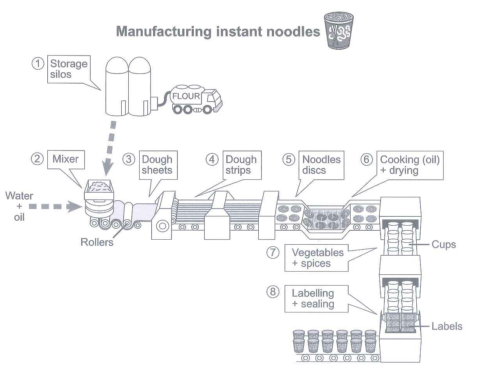
The diagram below shows how instant noodles are manufactured.
Summarize the information by selecting and reporting the main features and make comparisons where relevant.
Student answer (Band 6.5)
The diagram demonstrates the different steps of producing instant noodles in manufactories.
Overall, the production process envolves eight stages, beggining with flour storage silos and ending with labeling and sealing cups.
First, flour is transferred to giant silos to be stored before it gets used to prepare noodles. Second, a certain amount of flour is mixed with water and oil in a mixer until it transforms into a dough. Then, the dough passes by several rollers to be flatten into sheets before it gets cut into strips. After that, the strips are poured into noodles discs, as a result, they take the shape of a rounded disc then discs are cooked in hot oil and dryed before the next step begins.
In the last two stages, cups are filled with noodles discs along with vegetables and seasonings. Finally, the cups are ready to be consumed after they are labeled and sealed.
AI examiner evaluation
| Criterion | Band |
|---|---|
| Task Achievement / Task Response | 6.5 |
| Coherence and Cohesion | 6.5 |
| Lexical Resource | 6.0 |
| Grammatical Range and Accuracy | 6.0 |
| Overall | 6.5 |
Task Achievement / Task Response: Band 6.5
You give a clear overview of the eight-stage process, identifying flour storage as the starting point and labelling and sealing as the final stage. Most key steps are reported in sequence, including mixing, rolling, cutting, cooking and adding ingredients. This covers the task well, though some details are less fully or precisely described: the diagram shows dough strips being formed into noodle discs, rather than strips being “poured into” discs, and the cups are filled with noodles, vegetables and spices before labelling and sealing. The overview also says the process ends with labelling and sealing cups, while the diagram additionally shows finished cups emerging on a conveyor. More precise reporting of these final stages and the transformations between them would make the account more complete.
Coherence and Cohesion: Band 6.5
The response has a coherent overall structure: an introduction and overview are followed by the stages in chronological order. Sequencing expressions such as “First,” “Then,” “After that” and “Finally” help the reader follow the process. However, the linking can feel mechanical, and some connections between steps are not expressed clearly. For example, “After that, the strips are poured into noodles discs, as a result, they take the shape of a rounded disc then discs are cooked” combines several stages in a long, loosely joined sentence. The paragraphing is also limited, with most process details grouped together. Separate the shaping, cooking and packaging stages into clearer sentences and use reference words such as “these discs” to improve flow.
Lexical Resource: Band 6.0
You use an adequate range of process vocabulary, including “transferred,” “mixer,” “rollers,” “strips,” “cooked” and “sealed,” so the manufacturing sequence is generally understandable. There are also attempts at more specific description, such as “giant silos” and “rounded disc,” although these are not the most precise choices for this diagram. Some word-choice and spelling errors reduce accuracy: “manufactories” is unnatural here, “poured into noodles discs” does not describe the shaping stage accurately, and “envolves,” “beggining” and “dryed” are misspelled. Prefer standard process terms and check spelling, especially for key vocabulary. More precise collocations, such as “formed into noodle discs” and “dried,” would make the description clearer and more natural.
Grammatical Range and Accuracy: Band 6.0
You use a mix of simple and complex sentence forms, including clauses with “before,” “until” and “after,” and the sequence is generally easy to understand. Some grammatical errors remain, particularly in longer sentences. In “to be flatten into sheets,” the verb should be in the past participle form, and “as a result” is joined to the surrounding clauses without suitable punctuation. The sentence beginning “After that” also shifts between “they,” “discs” and “they” in a way that makes the reference less clear. The passive forms “is transferred,” “are cooked” and “are labeled and sealed” are appropriate for describing a process. Continue using varied structures, but divide long sequences into shorter sentences and check verb forms, clause boundaries and pronoun references.
See this exact question answered at other band scores. The same prompt compared across bands.
Browse more IELTS Writing model answers or get your own writing scored by the same AI examiner.