Band 4.5 IELTS Writing Task 1 Model Answer
Overall Band Score: 4.5 · Cambridge IELTS 15 · 2026-11-05
IELTS Writing Task 1 question
The diagram below shows how instant noodles are manufactured.
Summarize the information by selecting and reporting the main features and make comparisons where relevant.
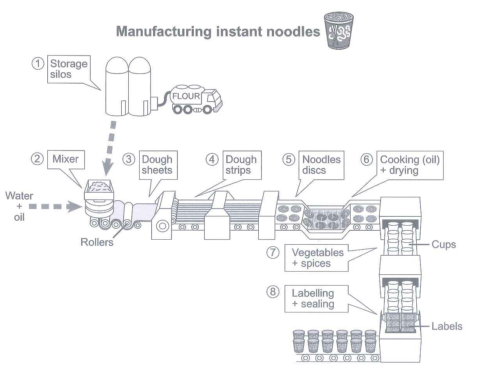
Student answer (Band 4.5)
The diagram illustrates that how the instant noodles are manufactured.
overall, this diagram the summery below that how the noodles manufacturing instant in all over tranformation.
The diagram show that the manufacturing instant noodles first of all, storage soilos flour deposit into the storage wardroob and the flour tranfer into the mixer machine that has flour add into mixer and more add water the produced rollers on dough sheets transfer to dough strips its has cuting into cercle cup and transfer to noodle discs and next into cooking oil + drying than add plus vegetables + spices add into cups than the cups are transfer into the labling ares the all cups wraping with lables of noodles advertise than the cups are transfer into the sealing packs of and the process are completed throw into the store and broker purchase the whole cotton and transfer into the market. the whole process of noodle instant manufacturing.
AI examiner evaluation
| Criterion | Band |
|---|---|
| Task Achievement / Task Response | 4.5 |
| Coherence and Cohesion | 4.5 |
| Lexical Resource | 4.5 |
| Grammatical Range and Accuracy | 4.5 |
| Overall | 4.5 |
Task Achievement / Task Response: Band 4.5
You identify the subject as the manufacture of instant noodles and mention several genuine stages, including flour storage, mixing, cooking and drying, and adding vegetables and spices. However, the account only minimally reports the process: the overview is unclear, and important steps such as forming dough sheets and strips, placing noodles into cups, and the final labelling and sealing stage are confused or omitted. You also add unsupported details about advertising, storage, brokers, cotton, and transport to market; these are not shown in the diagram. To improve, give a clear overview of the process from flour delivery to finished cups, then describe the stages in order using only information visible in the diagram.
Coherence and Cohesion: Band 4.5
There is an attempt to follow the manufacturing sequence, moving from flour storage through mixing and cooking to packaging, so the reader can recognise the general topic. However, the response is not arranged into clear paragraphs, and the opening overview does not provide a usable summary. Most stages are crowded into one long sentence, with repeated links such as “and” and “than,” making the relationships between steps difficult to follow. The ending introduces several new, unsupported stages rather than closing the process clearly. Use a brief introduction and overview, followed by one or two paragraphs that group the stages in sequence. Connect each step with precise transitions such as “next,” “after this,” and “finally.”
Lexical Resource: Band 4.5
You use some relevant process vocabulary, including “mixer,” “rollers,” “dough sheets,” “cooking oil,” and “vegetables + spices.” This shows an attempt to describe the diagram rather than relying entirely on general language. However, vocabulary is basic and often inaccurate or difficult to understand, as in “storage soilos,” “storage wardroob,” “cuting into cercle cup,” and “labling ares.” Several choices also misrepresent the process: “advertise,” “broker,” and “cotton” do not fit the diagram. Aim for accurate, repeated process terms rather than inventing details. Useful wording includes “storage silos,” “dough strips,” “noodle discs,” “cups are labelled and sealed,” and “finished cups.” Check spelling and word forms carefully.
Grammatical Range and Accuracy: Band 4.5
The response attempts to describe a sequence and includes some clauses linked by words such as “that” and “than.” However, sentence structures are very limited, and frequent errors make relationships between actions unclear. For example, “The diagram illustrates that how…” uses an incorrect clause pattern, while “the cups are transfer” has an incorrect verb form. Subject–verb agreement and tense are also inconsistent in “The diagram show” and “the process are completed.” The long final sentence contains many actions without clear sentence boundaries or punctuation. Practise short, accurate passive sentences for process descriptions, such as “The flour is transferred to a mixer” and “The cups are then labelled and sealed,” before combining stages into longer sentences.
See this exact question answered at other band scores. The same prompt compared across bands.
Browse more IELTS Writing model answers or get your own writing scored by the same AI examiner.