Band 6.5 IELTS Writing Task 1 Model Answer
Overall Band Score: 6.5 · Cambridge IELTS 15 · 2026-11-08
IELTS Writing Task 1 question
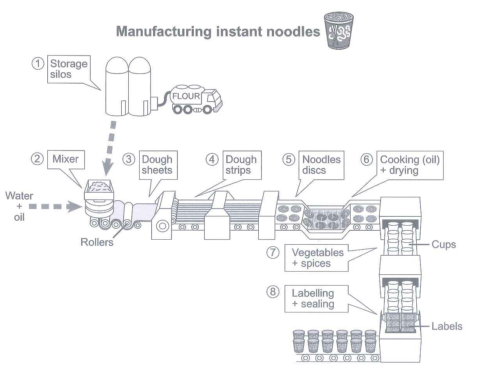
The diagram below shows how instant noodles are manufactured.
Summarize the information by selecting and reporting the main features and make comparisons where relevant.
Student answer (Band 6.5)
The diagram demonstrates the stages involved in the production of instant noodles.
Overall, the process consists of eight main stages beginning with the storage of flour and ending with the labelling and sealing.
Looking at the details, at first, silos are used for the storage of flour that is transported by the truck. Next water and oil is used for mixing the flour dough in the mixer. Then with the help of rollers, it is formed into dough sheets in the third stage resulting in the formation of long strips in the fourth stage.
In the next stage, the strips lead to make discs of noodles, subsequently these discs are cooked into oil and then drying. After cooking, the vegetables and spices are added in noodles and are placed into cups in the seventh stage. Finally, the are labels are used for labelling and sealing of cups in the eighth stage.
AI examiner evaluation
| Criterion | Band |
|---|---|
| Task Achievement / Task Response | 6.5 |
| Coherence and Cohesion | 7.0 |
| Lexical Resource | 6.0 |
| Grammatical Range and Accuracy | 5.5 |
| Overall | 6.5 |
Task Achievement / Task Response: Band 6.5
The response identifies the process as a sequence and gives a clear overview, from flour storage to labelling and sealing. It also reports several key stages in order, including mixing, forming sheets and strips, making noodle discs, cooking and adding vegetables and spices. This covers the main task, but some details are incomplete or unclear: the final cups are not explicitly described as the finished product, and the overview says the process ends with labelling and sealing rather than noting that finished cups emerge. The cooking and drying stage is also compressed into an awkward description. To strengthen the response, report the full sequence precisely, including the rollers and the final sealed cups.
Coherence and Cohesion: Band 7.0
The response is organised into an introduction, an overview and a detail paragraph, and the stages generally progress in the correct order. Sequencing expressions such as “Next,” “Then,” “In the next stage” and “Finally” help the reader follow the process. The progression is clear overall, although the detail paragraph places several stages into long, loosely connected sentences, which makes some relationships less easy to follow. For example, the sentence beginning “In the next stage” combines disc formation, cooking and drying without clearly separating the actions. The final sentence also contains a disruption that interrupts the flow. Use shorter stage-by-stage sentences and clearer links between each input, transformation and output.
Lexical Resource: Band 6.0
The vocabulary is adequate for describing a manufacturing process, with relevant terms such as “silos,” “mixer,” “rollers,” “dough sheets,” “strips” and “labelling and sealing.” The writer also varies some process language through phrases such as “resulting in the formation of” and “subsequently.” However, several word choices or collocations are inaccurate or unnatural: noodles are “cooked in oil,” not “cooked into oil,” and “the strips lead to make discs” does not express the transformation clearly. “The are labels” is an evident editing error. Aim for precise process verbs such as “pass through,” “are shaped into” and “are packaged,” and check the final wording for accidental repetitions or omissions.
Grammatical Range and Accuracy: Band 5.5
The response attempts a mix of simple and more complex structures, including a relative clause in “flour that is transported by the truck” and a result phrase in “resulting in the formation of long strips.” The sequence remains understandable, but some grammatical errors and awkward constructions persist. In “at first, silos are used for the storage of flour that is transported by the truck,” the passive clause can make it unclear whether the flour or silos are transported. “Water and oil is used” also has a subject–verb agreement error, while “these discs are cooked into oil and then drying” mixes verb forms. The final phrase, “the are labels are used,” contains a clear sentence-level error. Check agreement, parallel verb forms and sentence construction when describing each stage.
See this exact question answered at other band scores. The same prompt compared across bands.
Browse more IELTS Writing model answers or get your own writing scored by the same AI examiner.