Band 6.0 IELTS Writing Task 1 Model Answer
Overall Band Score: 6.0 · Cambridge IELTS 15 · 2026-11-10
IELTS Writing Task 1 question
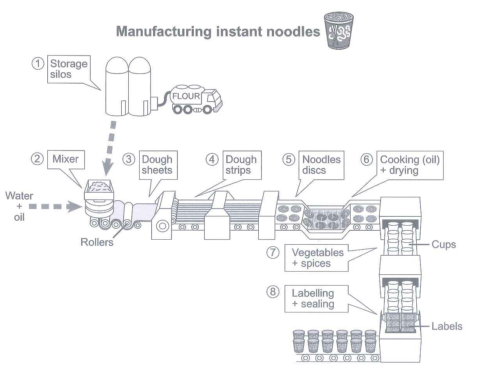
The diagram below shows how instant noodles are manufactured.
Summarize the information by selecting and reporting the main features and make comparisons where relevant.
Student answer (Band 6.0)
The diagram illustrates the step by step process of how instant noodles are prepared. The diagram explains the whole process in eight steps of manufacturing instant noodles, from the arrival of raw material to final packaging of the product.
At the beginning of the whole procedure, flour is delivered by trucks is stored in large storage solis. Then it is transferred into mixer. Then mixture is prepared with oil and water. The rollers are used to prepare dough sheets. Then these dough sheets are cut into dough strips. These strips are passed through noodles disc. These strips are shaped into round shaped disc before undergoing cooking process.Following this, noodles discs are cooked with hot oil and left to dry. Here, they are ready to be packed into cup, vegetables and spices are also addedd in cups. In the final stage, cups are lebeled and sealed and instant noodles are ready for distribution.
AI examiner evaluation
| Criterion | Band |
|---|---|
| Task Achievement / Task Response | 6.0 |
| Coherence and Cohesion | 6.5 |
| Lexical Resource | 5.5 |
| Grammatical Range and Accuracy | 5.0 |
| Overall | 6.0 |
Task Achievement / Task Response: Band 6.0
You cover the process from flour delivery through to the finished cups, and the opening gives a useful overall summary of its stages. Most key steps are included, including mixing, forming dough, cooking and drying, and adding vegetables and spices before sealing. However, some details are unclear or inaccurate: the strips do not pass through “noodles disc”; they are shaped into noodle discs, and the diagram shows the cups being filled with noodles and vegetables/spices before labelling and sealing. The overview also calls this an eight-step process without clearly distinguishing the stages. To strengthen the response, describe the sequence more precisely and make the overview identify the main transformation from flour into packaged cups.
Coherence and Cohesion: Band 6.5
The response follows the manufacturing sequence from beginning to end, so the reader can generally understand how one stage leads to the next. The opening and closing also frame the process clearly. However, the repeated use of “Then” makes the progression sound mechanical, and several stages are crowded together in one paragraph. The transition “Here, they are ready to be packed” is also unclear because it does not specify what is being packed or how the noodles enter the cups. Grouping the stages into a few logical sections and using varied, precise links such as “After shaping” and “Once dried” would make the progression smoother. The overall organisation is coherent, but cohesion and referencing are not consistently controlled.
Lexical Resource: Band 5.5
You use relevant process vocabulary, including “storage,” “rollers,” “dough sheets,” “cooked,” and “sealed,” which helps communicate the main stages. There is some useful variation in describing the product’s movement and transformation. However, several word choices and spelling errors reduce precision, such as “solis,” “lebeled,” and “addedd.” The phrase “passed through noodles disc” is also an inaccurate collocation, while “prepared” and “process” are repeated in general descriptions. Use the diagram’s specific terms consistently—for example, “formed into noodle discs”—and check spelling carefully. A broader set of accurate verbs for manufacturing stages would make the account more precise and natural.
Grammatical Range and Accuracy: Band 5.0
You attempt both simple sentences and longer structures, including “Following this, noodles discs are cooked with hot oil and left to dry.” The use of passive forms is appropriate for describing a process. However, some sentence structures are faulty, and errors sometimes make relationships between stages difficult to follow. For example, “flour is delivered by trucks is stored” combines two verb structures incorrectly, and “Then it is transferred into mixer” is missing an article. There are also problems with plurals and agreement in “vegetables and spices are also addedd in cups.” Aim to build accurate passive sentences, such as “The flour is delivered by truck and stored in silos,” and check articles, verb forms, and sentence boundaries.
See this exact question answered at other band scores. The same prompt compared across bands.
Browse more IELTS Writing model answers or get your own writing scored by the same AI examiner.