Band 5.5 IELTS Writing Task 1 Model Answer
Overall Band Score: 5.5 · Cambridge IELTS 15 · 2026-11-11
IELTS Writing Task 1 question
The diagram below shows how instant noodles are manufactured.
Summarize the information by selecting and reporting the main features and make comparisons where relevant.
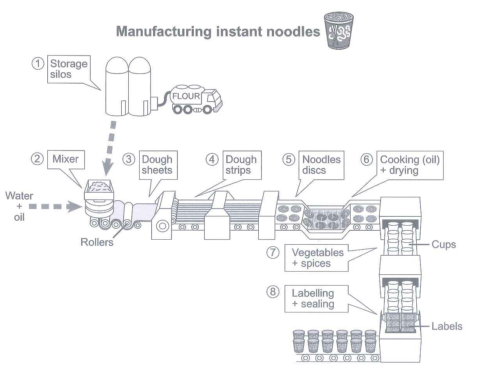
Student answer (Band 5.5)
The diagram illustrates the overall manufacturing process of instant noodles in 8 simple steps.
Overall, this is a manufacturing process that begins with storage silos filled with flour and then it mixed with water and oil and ends with labelling where the noodles are sealed in cups.
The process starts with the storage silos, where the flour is being stored and it is the primary ingredient in making instant noodles.The flour is then added to the mixer and it is then mixed with water and oil, then it rolls in dough sheets, followed by dough strips.Consequently, a noodles disc appears.The discs are then fried in cooking oil, after that it is put on some rest to properly dry.The noodles are then stored in cups where the usual vegetables and spicies are then added.The process of labelling starts at the outer layer of cups and then it is sealed until the further use.
AI examiner evaluation
| Criterion | Band |
|---|---|
| Task Achievement / Task Response | 5.5 |
| Coherence and Cohesion | 6.0 |
| Lexical Resource | 5.5 |
| Grammatical Range and Accuracy | 5.0 |
| Overall | 5.5 |
Task Achievement / Task Response: Band 5.5
You identify the process as having eight steps and give a relevant start and finish: flour is stored in silos, and the cups are labelled and sealed. The sequence is also broadly recognisable, including mixing, shaping, cooking and adding vegetables. However, some important stages are unclear or inaccurately described. The dough is not said to pass through rollers to form sheets and strips, and the noodles are not simply “stored in cups”: the diagram shows cups and vegetables/spices being added at a later stage. The overview also focuses on the endpoints rather than summarising the main transformation from flour to finished cups. Include the rollers and the separate stages of cooking/drying and cup filling to cover the process more fully.
Coherence and Cohesion: Band 6.0
The response follows the general order of the diagram, and the opening overview helps orient the reader. Sequencing expressions such as “The process starts,” “then,” and “Consequently” make the stages easy to follow overall. However, most information is placed in one long paragraph, so the overview and detailed stages are not clearly separated. Several transitions are repetitive, particularly the repeated use of “then,” and the relationship between stages is sometimes difficult to track in the long sentence beginning “The flour is then added.” Use a separate overview paragraph and a body paragraph for the sequence, with clearer links between each transformation. This would make the progression more controlled and reduce the mechanical feel of the linking.
Lexical Resource: Band 5.5
You use relevant process vocabulary, including “storage silos,” “mixer,” “dough sheets,” “dough strips,” and “labelling,” which allows the reader to recognise most stages. There is some variation in how you describe the process, but the range is limited and several choices are imprecise or unnatural. For example, “put on some rest” does not clearly describe drying, while “a noodles disc appears” is an awkward way to report the product emerging from the machinery. “Spicies” is also misspelled, and “usual vegetables” is not an accurate or natural description of the diagram’s vegetables and spices. Choose precise process verbs such as “pass through,” “emerge,” and “dry,” and check spelling and collocations.
Grammatical Range and Accuracy: Band 5.0
You attempt both simple and longer sentences, and the overall meaning can usually be followed. However, control is uneven, especially in longer clauses. In “and then it mixed with water and oil,” the verb form and reference are faulty; “it rolls in dough sheets” also gives the wrong grammatical relationship between the mixture and the sheets. There are further problems with articles and number in “a noodles disc,” and the sentence “The discs are then fried … after that it is put” shifts from plural to singular reference. Punctuation is also inconsistent, including the missing space after “noodles.” Break long sequences into shorter sentences and check subject–verb agreement, verb forms, and singular/plural references.
See this exact question answered at other band scores. The same prompt compared across bands.
Browse more IELTS Writing model answers or get your own writing scored by the same AI examiner.