Band 5.0 IELTS Writing Task 1 Model Answer
Overall Band Score: 5.0 · Cambridge IELTS 15 · 2026-11-12
IELTS Writing Task 1 question
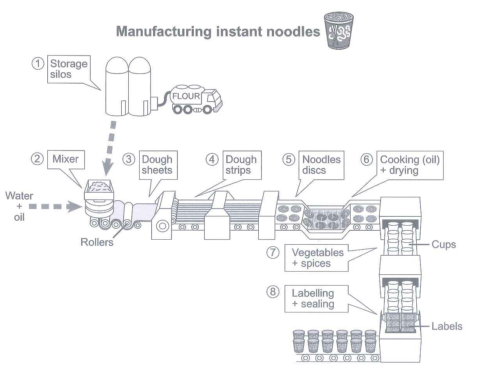
The diagram below shows how instant noodles are manufactured.
Summarize the information by selecting and reporting the main features and make comparisons where relevant.
Student answer (Band 5.0)
Summarization the manufacturing of noodles first of all noodles make by flour. the factory of noodles also have storage silos and flour enter the storage silos and after the storage silos sent flour to mixer and add water or oil in flour . After the machine sent dough sheets into rollers and the next step are making dough strip .The fifth step is make noodles discs and after cooking with oil and draying thee noodles discs. The seven step is adding vagitables or spices in noodles discs and putting the discs in the cup . The eight step is add labelling and selling the cups or pack it into the box and send it to the market for sales this is table of manufacturing of a noodles factory in my country there is a lot of factorys are making noodle i also like noodles very much and it is is very tasty food
AI examiner evaluation
| Criterion | Band |
|---|---|
| Task Achievement / Task Response | 4.5 |
| Coherence and Cohesion | 5.0 |
| Lexical Resource | 5.0 |
| Grammatical Range and Accuracy | 4.5 |
| Overall | 5.0 |
Task Achievement / Task Response: Band 4.5
You identify the broad sequence from flour storage through mixing, shaping, cooking, adding ingredients, and packaging, so the response is recognisably about the process. However, the account is only a partial description and does not give a clear overview of the process as a whole. Some stages are compressed or unclear: for example, the dough is formed into sheets and then strips by rollers, while your wording says the machine sends sheets “into rollers” and then moves directly to strips. You also describe the cups as being packed into a box and sent to market, which is not shown in the diagram. Focus on the stages actually illustrated and explain the transformation from dough to finished cups more accurately.
Coherence and Cohesion: Band 5.0
The response follows a broadly chronological order, and phrases such as “after” and “the next step” help the reader recognise the sequence. However, the progression is not consistently clear because many stages are joined in one long run-on passage, with little punctuation or paragraphing. The numbering is also confusing: “the fifth step” and “the seven step” are used without a consistent structure, and the final personal comments interrupt the process description rather than concluding it. Organise the response into a short introduction and overview followed by a clearly sequenced account. Use linking expressions selectively and make each sentence describe one or two connected stages.
Lexical Resource: Band 5.0
You use some relevant process vocabulary, including “storage silos,” “mixer,” “dough sheets,” “noodles discs,” and “labelling,” which helps convey the main subject. However, the range is limited and several word choices or spellings make the description less clear, such as “draying” for drying, “vagitables” for vegetables, and “selling” where the diagram shows sealing. Repeated use of “make,” “add,” and “step” also limits precision. Build a more accurate set of process verbs and collocations, such as “is transferred,” “is shaped into strips,” and “is cooked and dried.” Check spelling carefully, especially for key labels taken from the diagram.
Grammatical Range and Accuracy: Band 4.5
The response attempts to connect stages using longer sentences, but the structures are often faulty and the range remains limited. Errors in verb forms and agreement appear in phrases such as “noodles make by flour,” “the next step are making,” and “the fifth step is make.” Articles and sentence boundaries are also frequently missing, as in “add water or oil in flour,” while the final sentence contains repeated wording and unclear punctuation. These problems sometimes make the process difficult to follow. Practise accurate passive forms for process descriptions—for example, “The flour is sent to a mixer”—and use shorter, complete sentences with consistent tense and punctuation.
See this exact question answered at other band scores. The same prompt compared across bands.
Browse more IELTS Writing model answers or get your own writing scored by the same AI examiner.