Band 5.0 IELTS Writing Task 1 Model Answer
Overall Band Score: 5.0 · Cambridge IELTS 15 · 2026-11-13
IELTS Writing Task 1 question
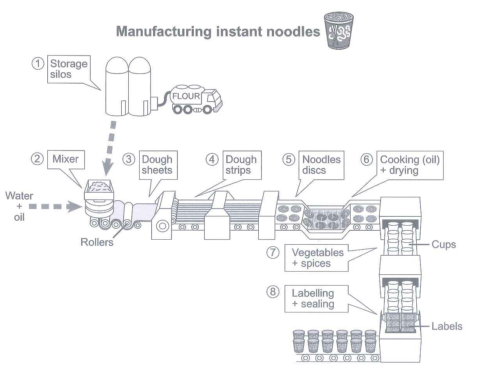
The diagram below shows how instant noodles are manufactured.
Summarize the information by selecting and reporting the main features and make comparisons where relevant.
Student answer (Band 5.0)
this is the image of the manufacturing instant noodles. here i am talking about how to make noodles at the manufacturing site. the first step of making noodle start with the flour which is storange in storage silos and then this fix with oil and some water then it machine has a roller which can mix the flour with water and oil easily then the thrid step of the dough sheets then all mixuture come at the fourt step which is dough strip after that the fifth step is the noodles disc which are the essiential to carrying the noodles easily.then sixth step is cooking oil plue drying and put in the cup then the seventh step is the vegetables plus spices which are add as the conviences the vegetables and spices are make very good teast of the noodle.and the last step of the manufacturing is the labelling of the item and sealing.
AI examiner evaluation
| Criterion | Band |
|---|---|
| Task Achievement / Task Response | 4.5 |
| Coherence and Cohesion | 5.5 |
| Lexical Resource | 5.0 |
| Grammatical Range and Accuracy | 5.0 |
| Overall | 5.0 |
Task Achievement / Task Response: Band 4.5
You identify the general subject and mention several stages, including flour storage, mixing, dough sheets and strips, cooking and drying, adding vegetables and spices, and final labelling and sealing. However, the process is reported only minimally and some details are inaccurate or unclear. For example, the rollers shape the dough rather than simply “mix the flour,” and the cups are introduced after cooking and drying, not at the cooking stage. There is no clear overview of the process as a whole, and the response does not explain the sequence precisely enough to give a complete account. Focus on the main stages in order and describe what happens at each one, avoiding unsupported comments about taste or convenience.
Coherence and Cohesion: Band 5.5
The response follows a broadly chronological order and uses sequence markers such as “the first step,” “then,” “after that,” and “the last step.” This gives the reader some sense of progression through the manufacturing process. However, the information is presented as one long, loosely connected passage, with no clear overview or paragraphing to distinguish the main stages. Several links are repetitive or awkward, and the chain of clauses beginning “then this fix with oil” and “then it machine has a roller” makes the sequence difficult to follow. Group the stages into a clear introduction/overview and a logically ordered description, and use concise linking phrases rather than repeatedly numbering each step.
Lexical Resource: Band 5.0
You use some relevant process vocabulary, including “storage silos,” “dough sheets,” “dough strip,” “noodles disc,” “vegetables plus spices,” and “labelling” and “sealing.” This shows a basic range connected to the diagram. However, vocabulary is often repetitive or imprecise, and several spelling and word-choice errors make parts difficult to understand, such as “storange,” “mixuture,” “essiential,” “conviences,” and “teast.” Phrases such as “the noodles disc which are the essential to carrying the noodles easily” do not clearly describe the diagram. Use accurate process verbs and collocations—for example, say that dough is rolled into sheets, cut into strips, and formed into discs—and check spelling carefully.
Grammatical Range and Accuracy: Band 5.0
You attempt to connect several stages in longer sentences, and the reader can generally recognise the intended sequence. However, sentence structures are limited and often faulty, which sometimes obscures the relationships between actions. For example, “the first step of making noodle start with the flour” has problems with subject–verb agreement and sentence construction, while “the vegetables and spices are make very good…” combines verb forms incorrectly. Articles, plurals, and tense are also inconsistent, as in “the noodles disc” and “which are add.” Use the present simple passive consistently for a process, such as “The flour is mixed with water and oil,” and separate stages into complete sentences with accurate subject–verb agreement and punctuation.
See this exact question answered at other band scores. The same prompt compared across bands.
Browse more IELTS Writing model answers or get your own writing scored by the same AI examiner.