Band 5.5 IELTS Writing Task 1 Model Answer
Overall Band Score: 5.5 · Cambridge IELTS 15 · 2026-11-15
IELTS Writing Task 1 question
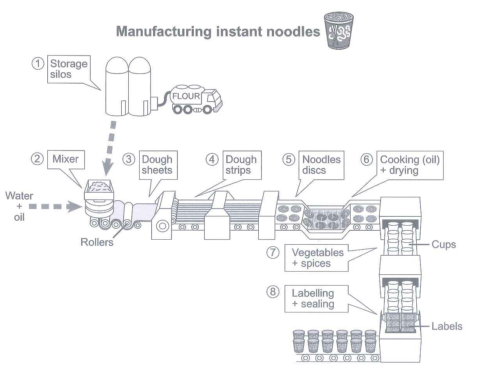
The diagram below shows how instant noodles are manufactured.
Summarize the information by selecting and reporting the main features and make comparisons where relevant.
Student answer (Band 5.5)
The provided diagram illustrates the various stages involved in the process of making instant noodles.
Overall, it is clearly noticeable that the process consists of 8 distinct steps, from storage silos to labels.
Looking at the details in more depth, initially flour store in storage silos. In second step, pour water and oil in to mixer and add flour as well as till it become dough. Moving on to the third step, pass the dough through rollers for making dough sheets. After that, convert the dough seets in to dough strips via help of machine knife. On fivth step, give round shape to dough strips that makes noodles disc.Following that cook the discs of noodles in oil and dry it, add some vegetables and spices in cups. Lastly, pack these cups, seal it and mark the labels.
In contrast, process diagram shows the all the stages of instant noodles manufacturing.
AI examiner evaluation
| Criterion | Band |
|---|---|
| Task Achievement / Task Response | 5.5 |
| Coherence and Cohesion | 5.5 |
| Lexical Resource | 5.5 |
| Grammatical Range and Accuracy | 5.0 |
| Overall | 5.5 |
Task Achievement / Task Response: Band 5.5
You identify the diagram as a manufacturing process and give a brief overview, noting that it has eight steps and begins with storage and ends with labelling. Most major stages are included, such as mixing, rolling, shaping, cooking, and adding vegetables and spices. However, the account is only partly complete: it does not clearly explain that flour is delivered to the silos, and the final stages are compressed into “pack these cups, seal it and mark the labels,” rather than describing the addition of ingredients and cups followed by labelling and sealing. The overview also says “from storage silos to labels,” which is less precise than summarising the transformation from flour into finished noodle cups. A clearer, more accurate overview and fuller reporting of the sequence would strengthen the response.
Coherence and Cohesion: Band 5.5
The response follows the general order of the process, and sequencing phrases such as “initially,” “After that,” “Following that,” and “Lastly” help the reader track the stages. The opening and overview also provide a basic frame for the description. However, progression is not consistently clear because several stages are crowded into one paragraph and some transitions are awkward or repetitive. For example, “Following that cook the discs of noodles in oil and dry it, add some vegetables and spices in cups” combines cooking, drying, and cup assembly without clearly showing how one stage leads to the next. The final sentence, “In contrast,” does not introduce a contrast and repeats the task’s general point. Use paragraphing to separate the overview from the sequence and choose linking expressions that accurately show order.
Lexical Resource: Band 5.5
You use relevant process vocabulary, including “storage silos,” “mixer,” “rollers,” “dough sheets,” “dough strips,” “noodles,” and “labels,” so the reader can recognise most stages. There are also attempts to vary wording, such as “various stages” and “manufacturing.” However, the range is limited and several word choices or forms are inaccurate, which makes parts of the process less clear. “Flour store” is not a natural way to describe the first stage, while “give round shape” and “mark the labels” do not precisely express forming noodle discs and applying labels. Spelling errors such as “seets” and “fivth” are noticeable. Aim for accurate process collocations and check spelling; precise verbs such as “feed,” “form,” and “seal” will help.
Grammatical Range and Accuracy: Band 5.0
You attempt both a longer opening sentence and a sequence of process descriptions, but the range of sentence structures is limited, and errors occur frequently. Several clauses lack a correctly formed verb or subject: “initially flour store in storage silos” and “In second step, pour water and oil in to mixer” are not complete, accurate descriptions. Tense and agreement are also inconsistent, as in “it become dough” and “cook the discs … and dry it.” Articles and sentence boundaries need attention, too; for example, “noodles disc.Following” has no space after the full stop, and “the process consists of 8 distinct steps” is followed by fragments in the main account. Practise complete passive process sentences, such as “The flour is stored…” and “The dough is passed through rollers…,” and check articles, verb forms, and punctuation.
See this exact question answered at other band scores. The same prompt compared across bands.
Browse more IELTS Writing model answers or get your own writing scored by the same AI examiner.