Band 6.0 IELTS Writing Task 1 Model Answer
Overall Band Score: 6.0 · Cambridge IELTS 15 · 2026-11-15
IELTS Writing Task 1 question
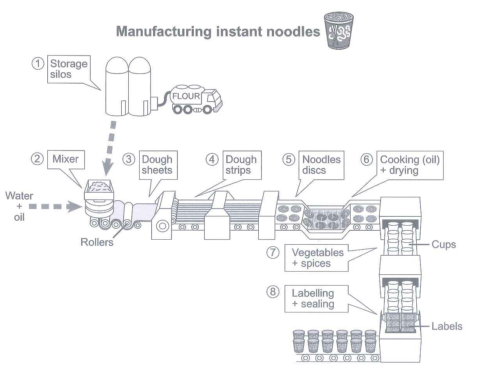
The diagram below shows how instant noodles are manufactured.
Summarize the information by selecting and reporting the main features and make comparisons where relevant.
Student answer (Band 6.0)
This diagram shows how instant noodles are manufactured in eight easy steps. The first step is storing the flour in silos. In the second step the flour will be mixed with water and oil which then goes through rollers and creates dough sheets. After that the dough strips will be created, which gets rolled in the next step and creates round noodles discs. The noodle discs will go through a cooking oil and drying process. After that some vegetables and spices will go into the cups with noodle discs. On the last step will the cups will be labelled and sealed with the brand name and logo. After all these eight steps there will be a final product: instant noodles which we can see in most supermarkets.
AI examiner evaluation
| Criterion | Band |
|---|---|
| Task Achievement / Task Response | 5.0 |
| Coherence and Cohesion | 6.5 |
| Lexical Resource | 6.0 |
| Grammatical Range and Accuracy | 5.5 |
| Overall | 6.0 |
Task Achievement / Task Response: Band 5.0
You identify the process as a sequence and report several key stages, including flour storage, mixing, shaping, cooking and drying, and adding vegetables and spices. However, the response only partially covers the diagram: it does not clearly describe the full progression from dough sheets to strips and discs, or explain that the finished cups emerge on a conveyor. The claim that there are “eight easy steps” is not supported by a clear account of all the stages, and “brand name and logo” is added detail not shown in the visual. The final supermarket comment is also outside the process information. The response is 23 words below the required minimum, which limits the detail available. Develop a concise overview and report the stages more completely.
Coherence and Cohesion: Band 6.5
The stages are presented in a generally logical order, and sequencing phrases such as “The first step,” “In the second step,” and “After that” help the reader follow the process. This gives the response a coherent overall arrangement. However, the repeated use of “After that” makes the linking somewhat mechanical, and the whole account is compressed into one paragraph. Some connections between stages are unclear—for example, the transition from dough sheets to strips and then to discs could be explained more explicitly. Grouping the process into an opening overview and a clearly sequenced description, while varying links such as “subsequently” and “following this,” would make progression smoother and cohesion more flexible.
Lexical Resource: Band 6.0
The vocabulary is adequate for describing a manufacturing process, with relevant terms such as “silos,” “rollers,” “dough sheets,” “noodles discs,” and “labelled and sealed.” These choices make the main stages understandable. However, the range is fairly narrow, and several phrases are imprecise or informal for an academic process description: “eight easy steps” adds an unnecessary judgement, while “some vegetables and spices will go into the cups” is less precise than describing them as being added. “Brand name and logo” is unsupported by the diagram. Use more exact process verbs and avoid adding details that are not visible; this would improve precision without requiring unnecessarily complex vocabulary.
Grammatical Range and Accuracy: Band 5.5
You use both simple sentences and some longer structures, including the relative clause in “water and oil which then goes through rollers.” The sequence is generally understandable, but some grammatical errors and awkward constructions remain. In “After that the dough strips will be created, which gets rolled,” the relative clause has unclear reference and “gets” does not agree with the plural “strips.” The sentence “On the last step will the cups will be labelled” has incorrect word order and repeats “will.” There is also inconsistent use of present and future forms (“shows,” “will be mixed,” “will go”), whereas process descriptions are usually written consistently in the present simple or passive. Practise accurate passive forms and vary sentence structures while checking agreement and word order.
See this exact question answered at other band scores. The same prompt compared across bands.
Browse more IELTS Writing model answers or get your own writing scored by the same AI examiner.