Band 6.5 IELTS Writing Task 1 Model Answer
Overall Band Score: 6.5 · Cambridge IELTS 15 · 2026-11-15
IELTS Writing Task 1 question
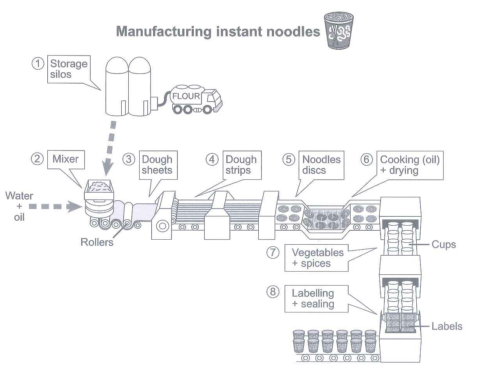
The diagram below shows how instant noodles are manufactured.
Summarize the information by selecting and reporting the main features and make comparisons where relevant.
Student answer (Band 6.5)
The diagram illustrate a linear process of manufacturing instant noodles from flour.
Overall, the process involves eight stages, beginning with storing flour into the storage silos and ending with packages of instant noodles. The main stages include, storing flour, mixing it to form dough, cooking and drying and packaging (labelling and sealing).
Intially, flour is stored into the spacious storage silos through a truck, using narrow pipes that connects truck to the silos. Flour is mixed thoroughly with water and oil in a larger mixer to form a dough. It is then moved through a roller to create a dough sheets, and then cut them into strips before they are turned into noodle discs.
In the sixth stage, the noodle discs are properly cooked in oil and then fully dried. Once it is dried, they are ready to put into cups. Next, it is flavoured with vegetables and spices. In the final stage, the tags are labelled on the cups and then it is sealed.
AI examiner evaluation
| Criterion | Band |
|---|---|
| Task Achievement / Task Response | 6.5 |
| Coherence and Cohesion | 6.5 |
| Lexical Resource | 6.5 |
| Grammatical Range and Accuracy | 6.0 |
| Overall | 6.5 |
Task Achievement / Task Response: Band 6.5
You give a clear account of the process from flour storage through to the finished cups, and your overview identifies the beginning, end, and several key stages. Most details match the diagram, including the addition of water and oil, the formation of sheets, strips and discs, and cooking and drying. Some features are less fully reported: the rollers are mentioned only generally, and the final stages could explain more clearly that vegetables and spices are added as the noodles enter cups, before the cups are labelled and sealed. The overview also says there are eight stages, but does not distinguish the numbered stages from the intermediate shaping steps. More precise coverage of these transitions would make the summary more complete and developed.
Coherence and Cohesion: Band 6.5
The response is organised into an introduction, an overview, and two paragraphs that follow the process from start to finish. Sequencing expressions such as “Overall,” “In the sixth stage,” “Once,” and “In the final stage” help the reader follow the production line. This gives the account a coherent overall progression. However, some links and references are less clear: “Once it is dried, they are ready to put into cups” shifts from singular “it” to plural “they,” and the transition from adding ingredients to labelling and sealing is compressed. The overview also repeats several stages that are then described in the body. Use clearer references and connect each stage explicitly to the next to make cohesion less mechanical and more precise.
Lexical Resource: Band 6.5
You use an adequate range of process vocabulary, including “storage silos,” “mixer,” “dough sheets,” “strips,” “noodle discs,” and “labelling and sealing.” These terms make the manufacturing sequence understandable, and “linear process” is an appropriate description. Some choices are imprecise or do not fit the diagram naturally: flour is stored “into” silos rather than “in” them, the truck does not itself store the flour, and “tags are labelled” is not a natural way to describe labels being applied. “Spacious,” “larger,” and “properly” add unsupported or unnecessary description. There is also a spelling error in “Intially.” More accurate process collocations and fewer subjective modifiers would improve precision and flexibility.
Grammatical Range and Accuracy: Band 6.0
You use a mix of simple and complex forms, including the overview sentence with “beginning … and ending …” and the sequence “before they are turned into noodle discs.” Most sentences communicate the process clearly, but some grammatical errors remain. The opening has subject–verb disagreement: “The diagram illustrate” should be “The diagram illustrates.” In “a dough sheets,” the article and plural noun do not agree, while “pipes that connects” also has a disagreement between the plural subject and verb. The sentence “Once it is dried, they are ready to put into cups” has unclear number agreement and an incomplete passive construction; use “Once they are dried, they are placed in cups.” Check agreement, articles, and passive forms, while retaining the range of sentence structures you already attempt.
See this exact question answered at other band scores. The same prompt compared across bands.
Browse more IELTS Writing model answers or get your own writing scored by the same AI examiner.