Band 5.5 IELTS Writing Task 1 Model Answer
Overall Band Score: 5.5 · Cambridge IELTS 15 · 2026-11-16
IELTS Writing Task 1 question
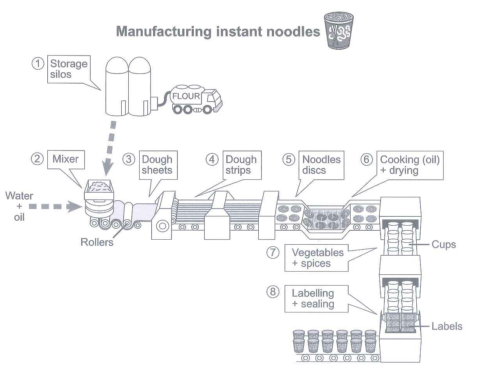
The diagram below shows how instant noodles are manufactured.
Summarize the information by selecting and reporting the main features and make comparisons where relevant.
Student answer (Band 5.5)
The diagram represents the complete making process of the noodles step by steps.Overall, shows the different steps which are used to make the noodle like mixer,silos storage,drying and labelling.
There are 8 steps of making a noodle in a factory.Firstly,we store the flour in the silo after that the flour is transfered to the mixer with the comination of water and oil next it is transfer with the help of rollers and make a dough sheets later on it is shaped in a dough strips after this process the machine changes the strips in the noodles discs then the discs are going in the cooking oil and drying procedure after that it is transfer in the cups and the vegetables and spices are added in the cups lastly, the cups are labelled and sealed for the sale.In this we see the complete procedure of making the noodles from the flour.
AI examiner evaluation
| Criterion | Band |
|---|---|
| Task Achievement / Task Response | 6.0 |
| Coherence and Cohesion | 6.0 |
| Lexical Resource | 5.5 |
| Grammatical Range and Accuracy | 5.0 |
| Overall | 5.5 |
Task Achievement / Task Response: Band 6.0
You cover the main sequence from flour storage through mixing, shaping, cooking, adding ingredients, and sealing, and your final sentence reinforces that this is a production process. However, the overview is not sufficiently clear: “Overall, shows the different steps” does not identify the key progression from raw flour to finished cups. Some details are also unclear or inaccurate. For example, the noodles are cooked in oil and dried before they enter the cups; the vegetables and spices are added at the cup-filling stage, rather than the discs simply being transferred into cups. You mention eight steps but do not clearly distinguish the rollers and the formation of dough sheets and strips. A more precise overview and fuller reporting of these stages would strengthen the response.
Coherence and Cohesion: Band 6.0
The response follows the manufacturing sequence, using markers such as “Firstly,” “after that,” “next,” and “lastly,” so the reader can generally follow the process. This gives the account an overall coherent arrangement. However, the linking is mechanical and the main process description is compressed into one long paragraph and sentence, with several stages joined by commas. This makes relationships between steps less clear, particularly around the rollers, dough sheets, strips, and noodle discs. The opening overview is also grammatically incomplete, which weakens the transition into the details. Separate the overview from the process description and use shorter sentences or clauses to group related stages; vary the sequencing language and make references such as “it” explicit.
Lexical Resource: Band 5.5
You use relevant process vocabulary, including “mixer,” “rollers,” “dough sheets,” “noodles discs,” “cooking,” “drying,” and “labelled and sealed.” These terms help communicate the stages, and the topic remains clear. However, the range is limited and several choices or forms are inaccurate or unnatural, such as “making process,” “step by steps,” “comination,” and “transfered.” Repetition of “after that” and “process” also makes the description less precise. Choose standard process collocations and use verbs that distinguish what happens at each stage, such as flour being fed into a mixer, dough being rolled into strips, and noodles being placed in cups. Check spelling and plural forms carefully.
Grammatical Range and Accuracy: Band 5.0
You attempt to connect stages in longer sentences, and the sequence is usually understandable. However, the response relies heavily on one extended sentence with repeated clauses, so the range of sentence structures is limited and control is uneven. The opening “Overall, shows” lacks a clear subject, while “the flour is transfered” and “it is transfer” show problems with verb forms and passive constructions. There are also missing articles or plural forms in phrases such as “make a dough sheets” and “a noodle.” Punctuation is inconsistent, with missing spaces after full stops and commas. Use a clear subject in each sentence, practise accurate passive forms such as “is transferred,” and divide the process into shorter, correctly punctuated sentences.
See this exact question answered at other band scores. The same prompt compared across bands.
Browse more IELTS Writing model answers or get your own writing scored by the same AI examiner.