Band 6.0 IELTS Writing Task 1 Model Answer
Overall Band Score: 6.0 · Cambridge IELTS 15 · 2026-11-16
IELTS Writing Task 1 question
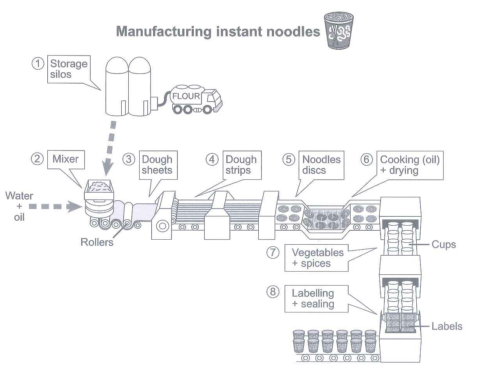
The diagram below shows how instant noodles are manufactured.
Summarize the information by selecting and reporting the main features and make comparisons where relevant.
Student answer (Band 6.0)
The picture illustrates complete process of manufacturing of instant noodles.
Intitially, the process starts with the flour, which is stored in the storage silos. Then the flour undergoes a long process, which inculdes mixing, dough making, striping, cooking and packing.
First of all, the flour is mixed with water and oil in a mixer, to make dough. After that, the dough is passed through the rollers to make the dough flat. Following this, the dough sheets are passed through a cutter in which the flat sheet of dough is cutted into strips. Then, these strips are shifted into a machine to make noodles discs. Following that, these discs are cooked in oil and dryed.
After drying, these noodels are ready to enter the packing process. Subsequently, the cooked noodles are shifrd into cups and vegetables and spices are added into these cups. After that, the cups are ready to enter the final stage, which is labeling and sealing. In this stage, the cups are labelled and sealed and ready to sale
AI examiner evaluation
| Criterion | Band |
|---|---|
| Task Achievement / Task Response | 5.5 |
| Coherence and Cohesion | 6.5 |
| Lexical Resource | 5.5 |
| Grammatical Range and Accuracy | 5.5 |
| Overall | 6.0 |
Task Achievement / Task Response: Band 5.5
You identify the diagram as a manufacturing process and report most of its main stages in the correct order, from flour mixing through to labelling and sealing. The account also includes relevant details such as adding water and oil, forming dough strips, cooking the noodle discs, and adding vegetables and spices. However, the overview is not sufficiently clear about the process’s full scope: it would help to state explicitly that it is a linear, multi-stage process ending with finished cups. Some details are imprecise or unsupported, such as saying the noodles are “shifted into cups”; the diagram shows the noodles entering a vertical filling stage where cups and ingredients are added. Clarifying this and describing the final product would make the summary more complete.
Coherence and Cohesion: Band 6.5
The response is arranged in a clear sequence, with an opening, a general account of the stages, and paragraphs that move from preparation to packaging. Linking expressions such as “First of all,” “Following this,” and “After drying” help the reader follow the process. This coherent organisation meets the expected standard, and the stages generally progress logically. To make the progression more flexible and less repetitive, vary the transitions and use clearer references when a stage changes. For example, “these discs” and “these noodles” are understandable, but a more explicit link between drying and the filling stage would improve continuity. A concise overview that groups the process into preparation, cooking, and packaging would also strengthen the paragraph structure.
Lexical Resource: Band 5.5
You use relevant process vocabulary, including “mixer,” “rollers,” “dough sheets,” “strips,” “cooked,” and “labelled and sealed,” so the reader can understand the main stages. However, the range is limited and several spelling or word-choice errors are noticeable: “Intitially,” “inculdes,” “cutted,” “dryed,” “noodels,” and “shifrd.” Some expressions are also imprecise for a process diagram, particularly “shifted into cups” and “ready to sale.” Aim for accurate technical verbs such as “formed,” “cut,” “dried,” “filled,” and “packaged.” More precise vocabulary would help distinguish the noodles entering the cups from the cups themselves moving through the production line.
Grammatical Range and Accuracy: Band 5.5
The response includes both simple sentences and some longer structures, such as “After that, the dough is passed through the rollers to make the dough flat.” The sequence is generally understandable, but grammatical control is uneven. The opening needs an article (“illustrates the complete process”), and “the flour undergoes a long process, which includes…” has an unclear subject because the later stages act on the dough and noodles, not the flour. There are also errors in verb forms and sentence construction, including “the flat sheet of dough is cutted” and “ready to sale.” Use consistent passive forms for the stages—for example, “the sheet is cut into strips”—and check articles and infinitive patterns. These corrections would make the process description more accurate and fluent.
See this exact question answered at other band scores. The same prompt compared across bands.
Browse more IELTS Writing model answers or get your own writing scored by the same AI examiner.