Band 5.5 IELTS Writing Task 1 Model Answer
Overall Band Score: 5.5 · Cambridge IELTS 15 · 2026-11-16
IELTS Writing Task 1 question
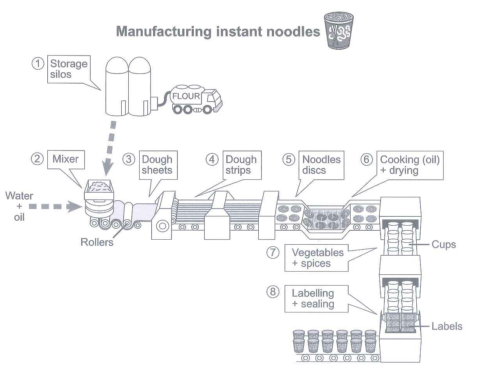
The diagram below shows how instant noodles are manufactured.
Summarize the information by selecting and reporting the main features and make comparisons where relevant.
Student answer (Band 5.5)
The process demostartes the stages involved in manufacturing instant noodles.
Overall, the process consists of eight stages beginning with storage silos, where flour is mixed with water to form dough and ending with labelling and sealing. Whole process is done through machines where they pack in the cups.
First, flour is stored in storage silos. Next, it is mixed with water and oil in rollers. After that, makes the dough sheets and with this dough sheets, makes the dough strips. Then, these strips are converted into noodles discs which is process through the cooking oil and drying.
In the seventh stage, vegetables and spices are packed in the cups. Resultantly, labelling and sealing are done on the cups. Finally, read for the sale in the markets.
AI examiner evaluation
| Criterion | Band |
|---|---|
| Task Achievement / Task Response | 5.5 |
| Coherence and Cohesion | 5.5 |
| Lexical Resource | 5.5 |
| Grammatical Range and Accuracy | 5.0 |
| Overall | 5.5 |
Task Achievement / Task Response: Band 5.5
You identify the process as manufacturing instant noodles and give a basic overview, from storage silos to labelling and sealing. Several key stages are also included, such as forming dough sheets and strips, making noodle discs, and cooking and drying them. However, some details are inaccurate or unclear: the flour is mixed with water and oil in the mixer, not “in rollers,” and the response omits the rollers’ role in shaping the dough and the final emergence of sealed cups. The ending, “ready for the sale in the markets,” is not clearly shown in the diagram. The response is also 24 words below the required minimum, limiting the detail available to report the process fully.
Coherence and Cohesion: Band 5.5
The response has a recognisable sequence, supported by transitions such as “First,” “Next,” “After that,” and “Finally,” and it is divided into an introduction, overview, and process description. This gives the reader a basic sense of progression. However, the sequence is not consistently clear: “After that, makes the dough sheets” has no stated subject, while “with this dough sheets, makes the dough strips” makes the relationship between stages difficult to follow. “Resultantly” is an awkward link, and the final sentence does not connect clearly to the preceding stage. To improve, use a clear sentence for each stage and refer explicitly to the product being processed, while keeping the stages in the diagram’s order.
Lexical Resource: Band 5.5
You use relevant process vocabulary, including “manufacturing,” “storage silos,” “dough sheets,” “dough strips,” “noodles discs,” and “labelling and sealing.” These terms help identify the main stages, and the vocabulary is generally adequate for communicating the topic. However, some word choices and combinations are inaccurate or unnatural: “mixed … in rollers” confuses the mixer with the rollers, “packed in the cups” is less precise than describing the ingredients as being added, and “read for the sale” appears to be an incorrect form. There is also a spelling error in “demostartes.” Aim for precise process verbs and check spelling and collocations so that the reader can distinguish each machine and action.
Grammatical Range and Accuracy: Band 5.0
You attempt both simple sentences and longer sequences, and the opening sentence communicates the topic clearly. However, grammatical control is inconsistent, particularly in clauses describing the stages. For example, “After that, makes the dough sheets” lacks a subject, and “with this dough sheets, makes the dough strips” has problems with both sentence structure and agreement. “Whole process is done through machines” is missing an article, while “noodles discs which is process” contains agreement and verb-form errors. These issues sometimes make the process difficult to follow. Use complete passive constructions consistently, such as “The dough is rolled into sheets, which are then cut into strips,” and check articles, plural agreement, and verb forms.
See this exact question answered at other band scores. The same prompt compared across bands.
Browse more IELTS Writing model answers or get your own writing scored by the same AI examiner.