Band 5.5 IELTS Writing Task 1 Model Answer
Overall Band Score: 5.5 · Cambridge IELTS 15 · 2026-11-17
IELTS Writing Task 1 question
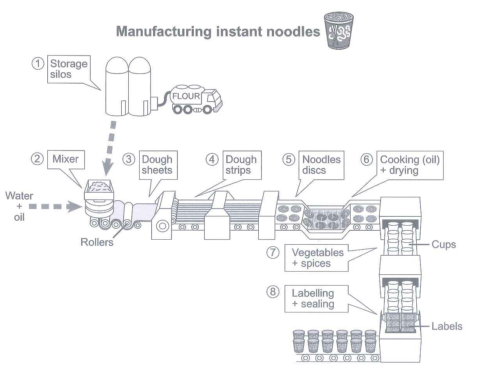
The diagram below shows how instant noodles are manufactured.
Summarize the information by selecting and reporting the main features and make comparisons where relevant.
Student answer (Band 5.5)
The process diagram illustrates the manufacturing of instant noodles.
Overall, the step starts from storage and end at the labeling process.
On the one hand, in the first step the raw material is store in silos then the flour is transferred through the truck. when the material is reached in industry the water and oil is mixed in flour and put into the roller machine. the rollers roll into sheet the dough sheets is formed. The dough is cut into long strips. subsequently reached to that area where dough is made into circular form called noodles discs.
On the other hand, cooking oil is dropped on the dough and air is blown through the noodles. the noodles are dry through the drying process. The spices and vegetables are added in the noodles and molded into cup shape. The labeling is added on the cover sheet where all the ingredients are written and seal the noodle cups.
AI examiner evaluation
| Criterion | Band |
|---|---|
| Task Achievement / Task Response | 5.5 |
| Coherence and Cohesion | 6.0 |
| Lexical Resource | 6.0 |
| Grammatical Range and Accuracy | 5.0 |
| Overall | 5.5 |
Task Achievement / Task Response: Band 5.5
You identify the diagram as a manufacturing process and cover its main stages, from flour storage through mixing, shaping, cooking, adding ingredients and packaging. However, the overview is too general: “the step starts from storage and end at the labeling process” does not summarise the process’s key transformation or its linear sequence. Some details are inaccurate or unclear. The diagram shows flour travelling from the truck into the silos, rather than being transferred from the silos by truck; it also shows noodles being cooked in oil and dried, not oil being dropped on them or air being blown through them. Cups are filled with noodles, vegetables and spices, rather than the noodles being moulded into cup shape. Report these stages more precisely and give a clearer overview.
Coherence and Cohesion: Band 6.0
The response has a recognisable overall structure: an introduction, a brief overview and two paragraphs covering the earlier and later stages. The sequence is generally understandable, and “subsequently” helps signal progression. However, “On the one hand” and “On the other hand” suggest a contrast between two alternatives, whereas these paragraphs describe consecutive parts of one process. Some links are also awkward or unclear, such as “when the material is reached in industry” and “subsequently reached to that area.” Use straightforward sequencing language such as “Next,” “After this” and “Finally,” and make each stage’s connection to the next explicit. This would improve cohesion while preserving the useful paragraph structure.
Lexical Resource: Band 6.0
You use an adequate range of process vocabulary, including “silos,” “rollers,” “dough sheets,” “strips,” “noodles discs” and “labeling.” These terms help communicate the stages, and “subsequently” shows an attempt to vary your language. Some word choices and collocations are inaccurate or imprecise, however: “cooking oil is dropped on the dough” does not describe the oil bath, “air is blown through the noodles” is not shown, and “molded into cup shape” misrepresents the packaging stage. “Cover sheet” is also unclear for the labels and sealing. Prefer precise process verbs such as “pass through,” “are fried,” “are dried,” “are placed in cups” and “are sealed.”
Grammatical Range and Accuracy: Band 5.0
You attempt both simple and longer sentences, and the reader can usually follow the intended sequence. However, errors in verb forms, agreement, articles and sentence construction are frequent enough to make some stages difficult to interpret. For example, “the step starts from storage and end” has a subject–verb agreement error, while “the raw material is store” needs a past participle. In “the rollers roll into sheet the dough sheets is formed,” the clauses are joined incorrectly and the subject and verb do not agree. Capitalisation after full stops is also inconsistent, as in “when.” Practise accurate passive forms for process descriptions—such as “the flour is mixed” and “the dough is cut”—and separate each stage into a complete, clearly punctuated sentence.
See this exact question answered at other band scores. The same prompt compared across bands.
Browse more IELTS Writing model answers or get your own writing scored by the same AI examiner.