Band 5.5 IELTS Writing Task 1 Model Answer
Overall Band Score: 5.5 · Cambridge IELTS 15 · 2026-11-18
IELTS Writing Task 1 question
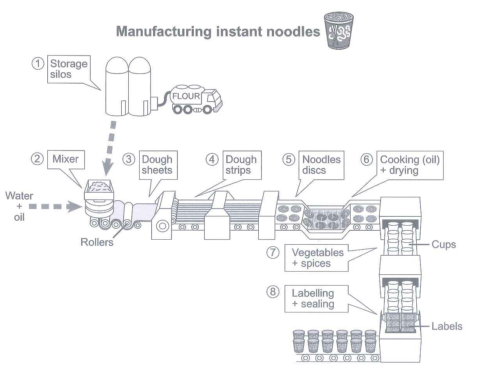
The diagram below shows how instant noodles are manufactured.
Summarize the information by selecting and reporting the main features and make comparisons where relevant.
Student answer (Band 5.5)
The process chart illustrates the production of instant noodles in eight stages.
Overall, the process begins with transporting flour to the factory and ends with labelling and hot sealing the noodles. Main key feature is flour undergoes a process which converts it into noodles disc in the fifth stage.
In stage one, flour stored in two mega cylinder shaped contains fills the truck with flour, then the truck goes to the manufacturing unit for further processing. Initially, in second stage flour is mixed with water and oil evenually then using rollers it moves to thrid stage called dough sheets which changes the shape of the mixture to strip form .
In fifth stage, the strips are spined to form a cd shape which is perfect for packing. Next dipped in cooking oil to enchance it's taste. Afterwards it gets dry. In addition, the dried noodles are filled in plastic cups with dry vegetables and spices in the seventh stage. Finally, it comes to label section to stick expery date and brand name and at the ending the cups are coved with hot sealed plastic cover on the top.
AI examiner evaluation
| Criterion | Band |
|---|---|
| Task Achievement / Task Response | 6.0 |
| Coherence and Cohesion | 6.0 |
| Lexical Resource | 5.5 |
| Grammatical Range and Accuracy | 5.0 |
| Overall | 5.5 |
Task Achievement / Task Response: Band 6.0
You identify the process as having eight stages and give a relevant overview of its start and finish, then describe mixing, shaping, cooking, adding ingredients and packaging. This covers the main stages, but some details are unclear or inaccurate: the flour is delivered from a truck into storage silos, rather than the silos filling the truck, and the noodles are cooked in oil and dried before being placed in cups. The overview’s claim that the fifth stage converts the mixture into noodle discs is also imprecise: dough is shaped into strips and then discs. To strengthen the response, report the sequence more precisely and include the key transition from dough sheets to strips to discs; avoid adding unsupported details such as a plastic cover being hot-sealed.
Coherence and Cohesion: Band 6.0
The response has a recognisable structure, with an overview followed by descriptions of the early and later stages. Sequencing expressions such as “Initially,” “Next,” “Afterwards” and “Finally” help the reader follow the process. However, the progression is not consistently clear: the first-stage description reverses the direction of flour transport, and the account jumps from the third stage to the fifth without clearly explaining how the strips become discs. Some sentences also contain several steps joined together, making relationships harder to follow. Use one clear paragraph for the overview and separate paragraphs for the process stages, while linking each stage explicitly to the next and using references such as “these strips” only when their meaning is unmistakable.
Lexical Resource: Band 5.5
You use some task-relevant vocabulary, including “rollers,” “dough sheets,” “strips,” “cooking oil,” “vegetables and spices,” and “labelling.” This gives you a useful foundation for describing a manufacturing process. However, several choices are inaccurate or unnatural, including “mega cylinder shaped contains,” “spined,” “cd shape,” and “hot sealed plastic cover.” Spelling errors such as “eventually,” “third,” “enhance,” and “expiry” also reduce precision. Aim for standard process vocabulary and accurate collocations: for example, say flour is “stored in silos,” dough is “cut into strips,” and the noodles are “formed into discs.” Check spelling carefully, especially for words used to identify stages or packaging.
Grammatical Range and Accuracy: Band 5.0
You attempt both simple and more extended sentences, and the overview uses a clear present-tense frame: “The process begins … and ends …”. However, some longer sentences are difficult to control, as in “Initially, in second stage flour is mixed … evenually then using rollers it moves…”. This contains missing articles, unclear clause boundaries and inconsistent sentence structure. There are also errors in verb forms and agreement, such as “flour stored” and “it gets dry,” as well as punctuation problems where separate steps are run together. Use a consistent present simple passive for the stages—for example, “The flour is mixed with water and oil, then passed through rollers”—and divide complex sequences into shorter, correctly punctuated sentences.
See this exact question answered at other band scores. The same prompt compared across bands.
Browse more IELTS Writing model answers or get your own writing scored by the same AI examiner.