Band 5.5 IELTS Writing Task 1 Model Answer
Overall Band Score: 5.5 · Cambridge IELTS 15 · 2026-11-18
IELTS Writing Task 1 question
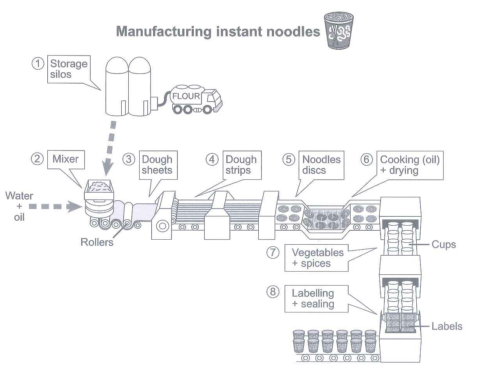
The diagram below shows how instant noodles are manufactured.
Summarize the information by selecting and reporting the main features and make comparisons where relevant.
Student answer (Band 5.5)
The diagram illustrate the process of produce instant noodles. The process devidded in eights steps.
Overall, it is a cyclic process, and every steps are equally important to making process complete. Row material used for making instant noodles was flour, water, and oil. It bigning with flour storage silos and ends up with labbeling and sealing the packages.
To commance with, the process of making instant noodles first step was flour storage silos. after that flour mix with water and oil in mixer. However a soft and spongy dough ready for making dough sheet it can shift with the help of roller to sheet making plate. this plate make layer of dough on the plate. meanwhile the prepare layer convert into dough stips through machine.
Furthermore, on that stage the strips was ready for making discs of instant noodles. Compared with step 5, at this point only noodles discs are rady. However the discs were cooked with oil and dried in step 6. after this process completed the dried discs was organised in cups. Furthermore vegetables and spices added to it. In the last stage of process packages sholuld be labelling and sealing.Here all the importent stages were completed which necessory fr makng instant noodles. now the packages of instant noodles were ready for sell.
AI examiner evaluation
| Criterion | Band |
|---|---|
| Task Achievement / Task Response | 5.5 |
| Coherence and Cohesion | 5.5 |
| Lexical Resource | 5.0 |
| Grammatical Range and Accuracy | 5.0 |
| Overall | 5.5 |
Task Achievement / Task Response: Band 5.5
You identify the main stages, from flour storage and mixing through shaping, cooking, adding ingredients, and packaging, and you include an overall statement about the beginning and end. However, the overview is not fully accurate: this is a linear process, not “cyclic,” and the diagram shows the finished cups emerging after labelling and sealing. Some details are unclear or unsupported, such as the dough being “soft and spongy” and the “sheet making plate.” The account also misrepresents the order around the cups: vegetables and spices are added as the noodles enter the cups, before labelling and sealing. To strengthen the response, give a precise overview and describe the stages in the diagram’s order without adding imagined details.
Coherence and Cohesion: Band 5.5
The response has an introduction, an overview, and two body paragraphs, and it generally follows the manufacturing sequence. Connectors such as “To commence with,” “Furthermore,” and “In the last stage” help signal progression. However, the progression is sometimes difficult to follow because several sentences are incomplete or joined unclearly, for example, “a soft and spongy dough ready for making dough sheet it can shift…” The repeated use of “However” does not express a contrast, and “Compared with step 5” interrupts rather than clarifies the sequence. Use one clear stage per sentence, link steps with accurate sequencing language, and make references such as “this plate” or “that stage” unambiguous.
Lexical Resource: Band 5.0
You use some relevant process vocabulary, including “mixer,” “rollers,” “dough sheets,” “strips,” “discs,” and “labelling and sealing,” so the reader can recognise the subject. However, the range is limited and several word-choice, word-form, and spelling errors make parts difficult to understand: “devidded,” “commance,” “labbeling,” and “necessory.” Some phrases are also unnatural, such as “packages should be labelling” and “ready for sell.” Aim for accurate process collocations and consistent terms from the diagram, such as “the dough is rolled into sheets” and “the cups are sealed and labelled.” Proofreading spelling and choosing precise verbs will improve clarity.
Grammatical Range and Accuracy: Band 5.0
You attempt both simple and more complex sentences, including clauses beginning with “after that” and “which,” but control is inconsistent. Frequent errors in agreement, tense, articles, and sentence boundaries sometimes make the process hard to follow. For example, “The diagram illustrate” needs subject–verb agreement, while “every steps are” has a singular/plural mismatch. In “after that flour mix with water and oil,” the passive form is needed to describe the process. Several clauses run together without punctuation, as in “a soft and spongy dough ready… it can shift.” Practise accurate passive constructions in the present simple and build shorter, complete sentences before combining stages.
See this exact question answered at other band scores. The same prompt compared across bands.
Browse more IELTS Writing model answers or get your own writing scored by the same AI examiner.