Band 5.5 IELTS Writing Task 1 Model Answer
Overall Band Score: 5.5 · Cambridge IELTS 15 · 2026-11-21
IELTS Writing Task 1 question
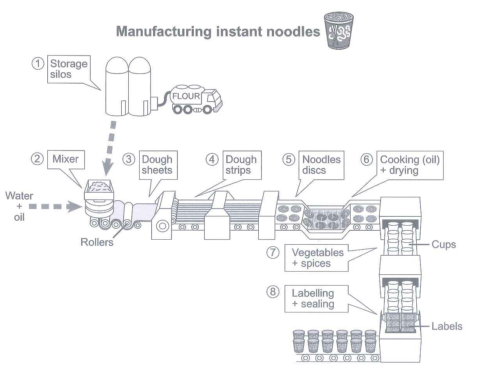
The diagram below shows how instant noodles are manufactured.
Summarize the information by selecting and reporting the main features and make comparisons where relevant.
Student answer (Band 5.5)
The digaram illustates the manufacturing methods of instant noodles.This process consists eight steps.
Overall, this process continue with storage, mixing, cooking and dying, labelling, and sealing. This is a huge process with the help of large modern machines.
As shown in the process, at the begining, flour stored in storage slios. So, flour is the main ingredient for the noodles, then flour mix with water and oil using electric mixer. After that, mixer turned to dough sheets by rollers. In the fourth stage, the sheets are converted into dough strips, which act as the noodles shape. Following this stage, strips makes dics in a round shape, then dics are cooked in deep fry and dryed.
Regarding the remaining steps, the cooked and dryed dics are packed to cups. In seventh stage, they added vegetables and spices packets to the cups, so it is a noteworthy change. These cup goes to labelling and sealing process in last stage. Finally, we can get manufactured instant noodles cup.
AI examiner evaluation
| Criterion | Band |
|---|---|
| Task Achievement / Task Response | 5.5 |
| Coherence and Cohesion | 6.5 |
| Lexical Resource | 5.5 |
| Grammatical Range and Accuracy | 5.0 |
| Overall | 5.5 |
Task Achievement / Task Response: Band 5.5
You identify the process as a sequence and include many key stages, from flour storage and mixing through shaping, cooking, adding ingredients, and sealing. The overview also recognises that this is a multi-stage manufacturing process. However, some details are inaccurate or unclear: the dough is not “turned to dough sheets by rollers” so much as passed through rollers to form sheets, and the cups are filled with the cooked noodle discs before vegetables and spices are added. The overview lists stages but does not clearly summarise the main transformation from flour to finished cups. To strengthen the response, describe the stages precisely and make the overview capture the process’s start, major transformations, and final packaged product.
Coherence and Cohesion: Band 6.5
The response has a clear overall sequence and is divided into an introduction, an overview, and two body sections. Linking phrases such as “After that,” “Following this stage,” and “Finally” help the reader follow the production stages. This coherent arrangement is a strength. Some connections are nevertheless mechanical or imprecise: “So” does not clearly express the relationship between flour storage and its role as an ingredient, while “Regarding the remaining steps” is a broad transition rather than a precise link. The reference in “These cup” is also unclear in number. For stronger progression, group related stages into paragraphs and use concise links that show sequence or transformation without adding unnecessary commentary.
Lexical Resource: Band 5.5
You use relevant process vocabulary, including “storage,” “mixer,” “dough sheets,” “dough strips,” “vegetables and spices,” and “labelling and sealing.” These terms make the general subject understandable. However, spelling errors such as “digaram,” “slios,” “begining,” “dics,” and “dryed” are noticeable, and several word choices or collocations are inaccurate: “dics” should be “discs,” “cooked in deep fry” is not natural, and “manufactured instant noodles cup” is awkward. “Noteworthy change” is also an unnecessary evaluation rather than a precise description. Aim for accurate process verbs and natural combinations, such as “formed into,” “deep-fried,” and “packaged in cups,” and proofread spelling carefully.
Grammatical Range and Accuracy: Band 5.0
You attempt both simple and more complex sentences, including the relative clause “which act as the noodles shape” and the sequence “Following this stage, strips makes…”. However, grammatical control is inconsistent, and errors occur in basic sentence patterns as well as longer clauses. For example, “This process consists eight steps” needs “consists of,” “flour stored” needs a passive verb, and “then flour mix” should use a correctly formed passive construction. There are also agreement and article problems in “These cup goes” and “in last stage.” Use consistent present-simple passive forms to describe the process, check singular and plural agreement, and punctuate sentence boundaries carefully. These corrections would make the stages easier to understand.
See this exact question answered at other band scores. The same prompt compared across bands.
Browse more IELTS Writing model answers or get your own writing scored by the same AI examiner.