Band 6.0 IELTS Writing Task 1 Model Answer
Overall Band Score: 6.0 · Cambridge IELTS 15 · 2026-11-21
IELTS Writing Task 1 question
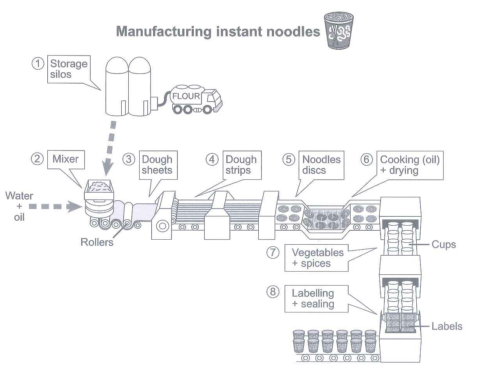
The diagram below shows how instant noodles are manufactured.
Summarize the information by selecting and reporting the main features and make comparisons where relevant.
Student answer (Band 6.0)
The diagram illustrates how instant noodles are produced in a factory.
Overall, the manufacturing process is based on saveral steps. In which, we can see how a flour is being processed and become ready to cook instant noodles by going through different stages. By following an organized process using different equipements, materials and other ingrediants as well.
In the beginning , raw material is brought into storage silos than is moved to a huge mixer where it is mixed up with water and oil. In next move, mixture is being transported through rollers as dough sheets. It is reshaped into dough strips and move forwarded to next stage to make them round disc shaped. In 5th stage noodles discs are being dipped into cooking oil and dryed for furthure procedure.
Furthermore, vegetables and spices added into it and packed in cups. Moreover, labelling and sealing is done upon packed cups in final step. Finally, instant noodels are ready after a long production process.
AI examiner evaluation
| Criterion | Band |
|---|---|
| Task Achievement / Task Response | 6.0 |
| Coherence and Cohesion | 6.5 |
| Lexical Resource | 5.5 |
| Grammatical Range and Accuracy | 5.0 |
| Overall | 6.0 |
Task Achievement / Task Response: Band 6.0
You identify the diagram as a manufacturing process and give a clear overall account that it moves from flour preparation to finished cups. Most key stages are included in the correct order: mixing flour with water and oil, forming sheets and strips, shaping discs, cooking and drying, then adding vegetables and spices before sealing. This covers the main process, but some details are less fully reported. For example, the flour is delivered by truck to storage silos, and the finished cups emerge on a conveyor; neither is clearly stated. The overview is also vague: “based on several steps” does not highlight the process’s linear progression or its main transformation from flour into packaged noodles. Make the overview more specific and report these endpoints precisely.
Coherence and Cohesion: Band 6.5
The response has a clear overall progression, with an introduction and overview followed by the early and later stages. Sequencing expressions such as “In the beginning,” “In next move,” “Furthermore,” and “Finally” help the reader follow the process, and the stages are generally presented in the right order. This is a solid organisational foundation. However, some linking is mechanical or unclear: “In which” does not connect naturally to the preceding sentence, while “Moreover” adds little between the final stages. The overview also repeats the idea of a long process without summarising its key phases. Use fewer, more precise transitions and group the stages into coherent phases, such as preparation and shaping, followed by cooking and packaging.
Lexical Resource: Band 5.5
You use relevant process vocabulary, including “storage silos,” “rollers,” “dough sheets,” “dough strips,” and “labelling and sealing,” which makes the stages recognisable. There is also some attempt to vary wording with “produced,” “processed,” and “packed.” However, several spelling errors—“saveral,” “equipements,” “ingrediants,” “dryed,” “furthure,” and “noodels”—are noticeable, and some expressions are imprecise or unnatural, such as “mixed up,” “move forwarded,” and “round disc shaped.” “A huge mixer” is also an unsupported description. Aim for accurate process collocations and check spelling carefully; precise terms such as “transferred,” “formed into discs,” and “dried” would make the account clearer and more formal.
Grammatical Range and Accuracy: Band 5.0
You attempt both simple and more complex sentence forms, and the sequence is usually understandable. However, control is uneven, particularly in clauses describing how one stage leads to another. For example, “In which” is an incomplete connection, and “a flour is being processed and become ready” has problems with the article and verb agreement. In “raw material is brought into storage silos than is moved,” the second clause needs a clear subject and the sequence requires a suitable connector. There are also tense and passive-form inconsistencies, such as “vegetables and spices added into it.” Use the present simple passive consistently for this process—for example, “The flour is transferred to a mixer, where it is combined with water and oil”—and check that each clause has a complete, correctly formed verb.
See this exact question answered at other band scores. The same prompt compared across bands.
Browse more IELTS Writing model answers or get your own writing scored by the same AI examiner.