Band 6.5 IELTS Writing Task 1 Model Answer
Overall Band Score: 6.5 · Cambridge IELTS 15 · 2026-11-22
IELTS Writing Task 1 question
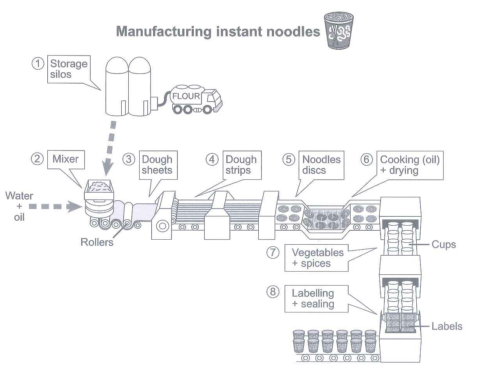
The diagram below shows how instant noodles are manufactured.
Summarize the information by selecting and reporting the main features and make comparisons where relevant.
Student answer (Band 6.5)
The given illustration depicts the process of instant noodles manufacturing.
Overall, it is an eight-step linear process which begins from storing floor in a large storage silos and ends at the labelling and sealing.
Initially, one of the main ingredients floor is transported by containers from storage silos at the site of manufacturing instant noodles. Next, floor is put into the mixer with water and oil which makes the paste of floor. Then, there are rollers which create thin dough sheets when paste passes through them. Subsequently, the dough sheets are converted into the dough strips to give them proper noodles shape. Afterwards, the noodles discs are created from the dough strips. In the sixth-step, the noodles dics are cooked in oil and dryed. In the seventh-step, all the manufactured noodles are put into the disposible cups along with vegetables and spices. Ultimately, all the cups are given labels and seals and ready for serving.
AI examiner evaluation
| Criterion | Band |
|---|---|
| Task Achievement / Task Response | 6.5 |
| Coherence and Cohesion | 7.0 |
| Lexical Resource | 6.0 |
| Grammatical Range and Accuracy | 6.0 |
| Overall | 6.5 |
Task Achievement / Task Response: Band 6.5
You cover the main stages from flour entering storage through mixing, shaping, cooking, adding ingredients, and packaging, and your overview correctly identifies the process as having eight steps. This gives the reader a clear account of the overall sequence. However, the overview says the process ends at labelling and sealing, while the diagram also shows the finished cups emerging on a conveyor. Some details are also unclear or inaccurate: flour is delivered by a truck to the silos, rather than transported from the silos by containers, and the noodles are cooked in oil and dried before vegetables and spices are added. The response therefore addresses the task well, but not all stages and relationships are reported precisely; adding the final output and clarifying these details would strengthen it further.
Coherence and Cohesion: Band 7.0
The response is organised into an introduction, a brief overview, and a chronological description, so the reader can follow the manufacturing sequence without difficulty. Sequencing expressions such as “Initially,” “Next,” “Subsequently,” and “Ultimately” help guide the account, and the stages are presented in a logical order. The progression is clear throughout, although the repeated step-by-step transitions make the description somewhat mechanical. There is also a small cohesion issue where “from storage silos” conflicts with the earlier reference to flour being transported to the silos, making the direction of movement less clear. Use a few more varied links and connect related stages into broader groups, while keeping the sequence explicit.
Lexical Resource: Band 6.0
You use a reasonable range of process vocabulary, including “mixer,” “dough sheets,” “dough strips,” “cooked,” and “labelling and sealing,” which makes the production stages recognisable. However, several spelling and word-choice errors reduce precision: “floor” is used for “flour,” “dics” for “discs,” and “dryed” for “dried.” Some phrases are also unnatural or imprecise, such as “containers from storage silos” and “proper noodles shape.” Choose standard process collocations and check spelling carefully, especially for key ingredients and products. More precise verbs such as “delivered,” “formed,” and “packaged” would help you describe the diagram more naturally without changing its meaning.
Grammatical Range and Accuracy: Band 6.0
You use both simple sentences and more developed structures, including the relative clause in “dough sheets are converted into the dough strips to give them…” and the time clause “when paste passes through them.” Most of the sequence remains understandable, and the passive voice is appropriate for describing a manufacturing process. Some grammatical errors persist, however. For example, “storing floor in a large storage silos” has an incorrect article and number agreement, while “Next, floor is put into the mixer” needs an article or a more suitable uncountable-noun construction. “In the sixth-step” also has an unnecessary hyphen and article pattern. Review articles, singular/plural agreement, and sentence phrasing to make the process description more consistently accurate.
See this exact question answered at other band scores. The same prompt compared across bands.
Browse more IELTS Writing model answers or get your own writing scored by the same AI examiner.