Band 6.0 IELTS Writing Task 1 Model Answer
Overall Band Score: 6.0 · Cambridge IELTS 15 · 2026-11-22
IELTS Writing Task 1 question
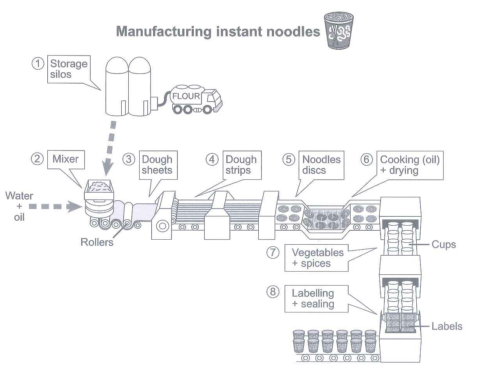
The diagram below shows how instant noodles are manufactured.
Summarize the information by selecting and reporting the main features and make comparisons where relevant.
Student answer (Band 6.0)
The digram given below shows how instant noodles are manufactured.
Overall it is evident that, the manufacturing of instant noodles starts by basic flour and undergoes mainly 8 steps to prepare the noodles completly.
On a closer observation it can be seen that, the flour is baught and stored in the factory's storage silos. The flour it later passed to the mixers adding water and oil to form a dough sheet which will undergo a machine with will falten the dough and also cut it into strips. After cutting the dough into strips the dough is rolled into into noodles discs and the discs are fired in oil. After frying the noodle discs are dried before any other further process.
Furthermore, the fried and dried noodle discs are transfured into cups with the necessery vegetables and spices in sachits, After adding the necessary stuff the cups are taken into the next and last process which is sealing and labaling. after completion of all the steps the instant noodle cups are ready for marketing.
AI examiner evaluation
| Criterion | Band |
|---|---|
| Task Achievement / Task Response | 6.5 |
| Coherence and Cohesion | 6.5 |
| Lexical Resource | 5.5 |
| Grammatical Range and Accuracy | 5.0 |
| Overall | 6.0 |
Task Achievement / Task Response: Band 6.5
The response covers the main sequence from flour storage through mixing, shaping, cooking and drying, then adding ingredients and sealing the cups. The opening overview identifies a start and a multi-stage process, and the account includes relevant details such as water and oil being added and the noodles being cooked in oil. Some stages are less fully or precisely reported: the rollers and the formation of dough sheets are compressed into one sentence, and the addition of vegetables and spices is described as putting the discs into cups, rather than clearly showing the ingredients being added at that stage. The claim that flour is “bought” and that the cups are ready “for marketing” is not shown in the diagram. A clearer overview of the linear process and more exact reporting of the final stages would strengthen the response.
Coherence and Cohesion: Band 6.5
The response has a coherent overall arrangement: it begins with an overview, follows the manufacturing sequence, and ends with the finished product. Sequencing phrases such as “After cutting” and “After frying” help the reader follow the process. However, cohesion is sometimes mechanical, with repeated transitions such as “After” and “Furthermore,” and the long middle paragraph combines several stages without clear breaks. Some references are also unclear: “the next and last process” could be stated more directly as labelling and sealing, while “the necessary stuff” does not clearly identify the vegetables and spices. Organising the stages into two body paragraphs and using precise references to each product at each point would make the progression smoother and more controlled.
Lexical Resource: Band 5.5
The response uses enough process-related vocabulary to communicate the main stages, including “storage silos,” “dough,” “strips,” “noodles discs,” “oil,” and “sealing.” There are also attempts at more specific language, such as “transferred” and “undergoes.” However, spelling errors are noticeable, including “digram,” “completly,” “baught,” “falten,” “transfured,” “necessery,” and “labaling.” Some choices are imprecise or informal for an academic process description: “stuff” and “ready for marketing” are less suitable, and “fired in oil” is not the natural expression for this stage. Use accurate process verbs and collocations, and proofread spelling carefully; this would make the vocabulary more precise and easier to read.
Grammatical Range and Accuracy: Band 5.0
The response attempts both simple and complex sentences, including a relative clause in “a machine with will falten the dough” and a time clause beginning “After adding…”. The overall sequence remains understandable, but grammatical control is uneven. For example, “the flour it later passed” has an incorrect subject and verb form, while “the dough…which will undergo” shifts tense and gives the dough an unclear role in the process. The sentence beginning “After adding…” is a fragment, and the final sentence starts with a lowercase “after” following a full stop. Commas after introductory phrases are also used inconsistently. Aim for consistent present simple passive forms for process stages, and check that each sentence has a clear subject and finite verb.
See this exact question answered at other band scores. The same prompt compared across bands.
Browse more IELTS Writing model answers or get your own writing scored by the same AI examiner.