Band 5.0 IELTS Writing Task 1 Model Answer
Overall Band Score: 5.0 · Cambridge IELTS 15 · 2026-11-22
IELTS Writing Task 1 question
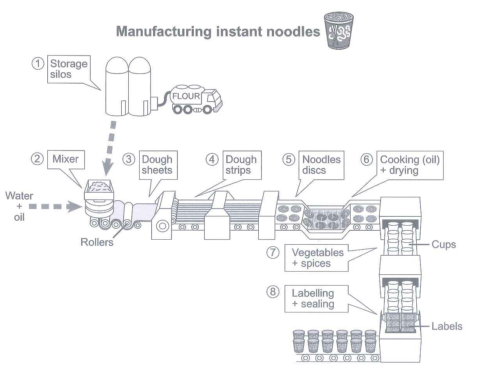
The diagram below shows how instant noodles are manufactured.
Summarize the information by selecting and reporting the main features and make comparisons where relevant.
Student answer (Band 5.0)
Manufacturing of instant noodles starts with with raw material which is basically flour. Flour got stored in big silos and then the main process starts. It get transfer to the mixer chamber where it gets mixed with water and oil and than it goes into the rollers through roller it transfers into the dough sheets where it gets spread into sheets and then it moved into dough strips where it is turns into strips from sheets. Than with the help of a convary belt it goes into the noodles disc than further it cooked with oils at a specific temperature and than simultaneously dried and gets into cups than the cups gets its toppings of vegetables and different type of spices than through a convary belt its goes into the labeling section where it gets its label and sealed. This is a general idea of making of noodles in a manufacturing plant.
AI examiner evaluation
| Criterion | Band |
|---|---|
| Task Achievement / Task Response | 5.0 |
| Coherence and Cohesion | 5.5 |
| Lexical Resource | 5.5 |
| Grammatical Range and Accuracy | 4.5 |
| Overall | 5.0 |
Task Achievement / Task Response: Band 5.0
You identify the main stages, from flour storage and mixing through shaping, cooking, drying, adding toppings, and sealing, so the response is relevant to the process. However, the account is only partial: it does not clearly describe the dough strips becoming noodle discs before cooking, and it omits the final cups emerging on a conveyor. There is also no concise overview highlighting the process as a sequence from raw flour to packaged cups. Some details are vague or unsupported, such as saying the noodles are cooked “at a specific temperature,” which the diagram does not show. To strengthen the response, report the stages more precisely and include the key beginning and end points.
Coherence and Cohesion: Band 5.5
The stages are generally presented in the correct order, and words such as “then” and “where” help connect the process. This gives the reader a basic sense of progression. However, nearly the entire description is packed into one long sentence, with repeated “than/then” links, so the sequence becomes difficult to follow. Some connections are unclear, for example, “it goes into the rollers through roller it transfers into the dough sheets.” Organise the process into a short introduction or overview followed by stages grouped into paragraphs, and use clearer sequencing expressions such as “next,” “after this,” and “finally.” This would make the progression easier to track without relying on repetitive connectors.
Lexical Resource: Band 5.5
You use relevant process vocabulary, including “silos,” “mixer,” “dough sheets,” “dough strips,” “vegetables,” and “sealed,” which helps communicate the general manufacturing sequence. However, the range is limited and several choices are imprecise or repetitive. “Gets” and “goes into” recur frequently, while “toppings” is less suitable for the diagram’s addition of vegetables and spices during cup filling. There are also spelling errors such as “convary” and “labeling” is less consistent with the British spelling expected in IELTS. Aim for more precise process verbs, such as “is transferred,” “is shaped,” and “is packaged,” and check spelling and collocations carefully.
Grammatical Range and Accuracy: Band 4.5
The response attempts to link several stages in longer sentences, but the structures are often faulty, and the range remains limited. Errors include “Flour got stored,” “It get transfer,” and “the cups gets,” where tense, verb form, and subject–verb agreement are not controlled. The repeated use of “it” also makes some references unclear, and the long sentence beginning “It get transfer to the mixer chamber” contains several clauses without effective punctuation. Use the present simple passive consistently for a process description—for example, “The flour is transferred to the mixer”—and separate each major stage into a complete sentence. This would improve accuracy and make the sequence easier to understand.
See this exact question answered at other band scores. The same prompt compared across bands.
Browse more IELTS Writing model answers or get your own writing scored by the same AI examiner.