Band 6.0 IELTS Writing Task 1 Model Answer
Overall Band Score: 6.0 · Cambridge IELTS 15 · 2026-11-22
IELTS Writing Task 1 question
The diagram below shows how instant noodles are manufactured.
Summarize the information by selecting and reporting the main features and make comparisons where relevant.
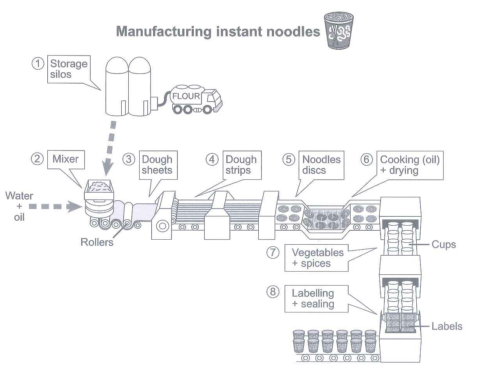
Student answer (Band 6.0)
The process diagram illustrates manufacturing in a industry of special noodles called as 'instant noodles'.
Overall, the diagram covers eight stages for making noodles through different processes from storage to sealing the noodle packets.
To begin with, a truck of floor stores ingredient called as 'storage silos' which is then put into the mixer, mixing it with water and oil and producing dough sheets with the help of rollers. Moving on to the next stage, while on roller belt, the dough sheets are further converted into dough strips.
In the next subsequent stage, noodles starts taking shape called as 'noodles discs'. In the next phase, discs are cooked and dried while passing through a container. Next stage, cups placed in their positions, noodles are put into cups, while other ingredients such as vegetables along spices gets mixed in cups. Finally, labeling and sealing of cups is carried out and noodles are packed.
AI examiner evaluation
| Criterion | Band |
|---|---|
| Task Achievement / Task Response | 6.0 |
| Coherence and Cohesion | 6.0 |
| Lexical Resource | 6.0 |
| Grammatical Range and Accuracy | 5.5 |
| Overall | 6.0 |
Task Achievement / Task Response: Band 6.0
You identify the process as a sequence from flour storage through mixing, shaping, cooking, adding ingredients, and sealing, and your overview correctly notes that it has eight stages. Most key stages are included in the right order, so the response addresses the task. However, some details are unclear or incomplete: the flour is delivered by truck to the storage silos, rather than the truck itself storing an ingredient, and the dough strips are formed from dough sheets before being shaped into noodle discs. The account of the final filling stage also does not clearly explain that the cooked noodles enter cups and vegetables and spices are added. A more precise overview and fuller description of these transitions would make the main features clearer.
Coherence and Cohesion: Band 6.0
The response has a clear overall arrangement: an introduction, an overview, and a chronological account of the process. Sequencing phrases such as “To begin with,” “Moving on,” and “Finally” help the reader follow the stages. However, the repeated use of “next stage” and “In the next phase” makes the progression somewhat mechanical, and some links between actions are difficult to follow. For example, “Next stage, cups placed in their positions, noodles are put into cups” combines several steps without clearly showing their relationship. Use a wider range of linking structures and make each sentence focus on a clearly connected stage. This would improve the flow while retaining the effective chronological organisation.
Lexical Resource: Band 6.0
You use an adequate range of process vocabulary, including “mixer,” “rollers,” “dough sheets,” “dough strips,” “cooked and dried,” and “labeling and sealing.” These terms help communicate the main stages, and the meaning is generally understandable. Some word choices and collocations are inaccurate or imprecise, however: “floor” appears to mean “flour,” “a truck of floor stores ingredient” does not clearly describe delivery to silos, and “noodles starts taking shape called as ‘noodles discs’” is awkward. “Container” is also less precise than describing the cooking-and-drying bath. Aim for accurate process nouns and natural verb combinations, such as “flour is transported,” “the dough is shaped,” and “the noodles are portioned into cups.”
Grammatical Range and Accuracy: Band 5.5
You attempt both simple and more complex sentence forms, including the overview sentence and clauses beginning “while” and “which.” The sequence remains understandable, but some grammatical errors recur. For example, “a industry” needs the article “an,” “noodles starts” has a subject–verb agreement error, and “cups placed in their positions” lacks a finite verb. The sentence beginning “Next stage” also joins actions without a complete, clearly structured clause. Check articles, agreement, and verb forms, and ensure each sentence has a clear subject and main verb. More consistently accurate complex sentences would strengthen the description without requiring more complicated structures.
See this exact question answered at other band scores. The same prompt compared across bands.
Browse more IELTS Writing model answers or get your own writing scored by the same AI examiner.