Band 6.0 IELTS Writing Task 1 Model Answer
Overall Band Score: 6.0 · Cambridge IELTS 15 · 2026-11-23
IELTS Writing Task 1 question
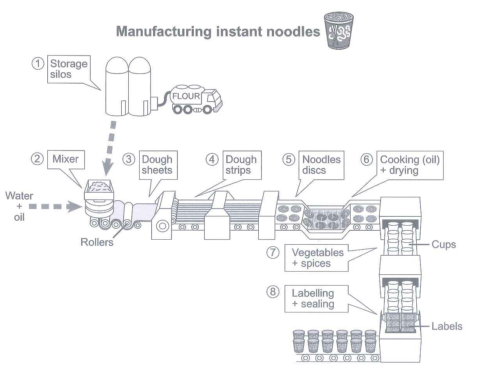
The diagram below shows how instant noodles are manufactured.
Summarize the information by selecting and reporting the main features and make comparisons where relevant.
Student answer (Band 6.0)
The illustration shows the production of how instant noodles are made.
Overall, the proccess of manufacturing instant noodles holds 8 steps, which starts by receiving much flour in a storage silos until labelling and sealing the noodle cups. Each steps has to be done chronologically in order to manufacture good instant noodles.
The process starts by receiving flour in a storage silos. Those flour will be mixed with water and oil in a mixer, forming a dough. The dough will be rolled using rollers to flattened it until it looks like sheets. These dough sheets will be cutted horizontaly as strips in a machine, which will be then seperated into several groups. In each group, the dough strips will be shaped circulary like discs, called the noodles discs. These noodles discs will be cooked with oil, and it will be dried after.
After the whole cooking and drying process, the dried noodles will be placed into several cups with vegetabales and spices added to it. Lastly, the cups will be sealed and labelled.
AI examiner evaluation
| Criterion | Band |
|---|---|
| Task Achievement / Task Response | 6.5 |
| Coherence and Cohesion | 7.0 |
| Lexical Resource | 5.5 |
| Grammatical Range and Accuracy | 5.5 |
| Overall | 6.0 |
Task Achievement / Task Response: Band 6.5
You cover the main stages in the correct order, from flour storage through mixing, shaping, cooking and drying, to adding vegetables and spices and sealing the cups. The overview also identifies the process as a sequence with a clear beginning and end. This is a solid account of the diagram, but some details are incomplete or imprecise: the final cups are labelled as well as sealed, and the diagram shows the noodles entering cups in a vertical filling stage, rather than simply being “placed into” them. The claim that there are eight steps is reasonable, though the description could distinguish the rollers and the separate shaping stages more clearly. More precise reporting of these features would make the coverage more complete.
Coherence and Cohesion: Band 7.0
The response is organised into an introduction, a brief overview and two chronological paragraphs, so the reader can follow the manufacturing sequence without difficulty. Linking expressions such as “Overall,” “The process starts,” “After,” and “Lastly” help signal progression, and the shift from preparation to packaging is logical. The sequence is generally clear, although some references are less precise: “Those flour” and “it” in the cooking sentence make the intended nouns harder to track. The overview also repeats the start-to-finish sequence rather than highlighting the main transformation from flour into packaged noodles. Use clearer noun references and make the overview more selective to strengthen an already coherent structure.
Lexical Resource: Band 5.5
You use relevant process vocabulary, including “mixer,” “rollers,” “dough sheets,” “strips,” “discs,” and “cooking and drying,” which makes the stages recognisable. However, the range and control are limited by several inaccurate forms and collocations, such as “proccess,” “cutted,” “seperated,” “vegetabales,” and “horizontaly.” Some wording is also awkward or imprecise: “receiving much flour” and “holds 8 steps” do not sound natural in a process description, while “shaped circulary” is not the appropriate form. Aim for accurate technical nouns and natural process verbs, and check spelling and word forms carefully; these improvements would make the description more fluent and precise.
Grammatical Range and Accuracy: Band 5.5
You attempt a mixture of simple and more complex sentences, including the overview clause “which starts…” and the time clause “After the whole cooking and drying process…”. The overall meaning remains understandable, but some grammatical errors recur. For example, “the process … holds 8 steps” has an awkward verb pattern, “Each steps has” has a number-agreement error, and “Those flour will be mixed” has a demonstrative and agreement problem. In “using rollers to flattened it,” the infinitive form is incorrect, and “it will be dried” does not clearly agree with the plural noodles discs. Practise agreement, articles and pronoun reference, and use passive forms consistently when describing stages. Greater accuracy across these structures would improve control.
See this exact question answered at other band scores. The same prompt compared across bands.
Browse more IELTS Writing model answers or get your own writing scored by the same AI examiner.