Band 5.5 IELTS Writing Task 1 Model Answer
Overall Band Score: 5.5 · Cambridge IELTS 15 · 2026-11-23
IELTS Writing Task 1 question
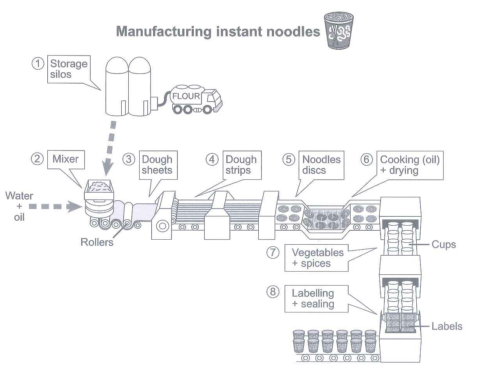
The diagram below shows how instant noodles are manufactured.
Summarize the information by selecting and reporting the main features and make comparisons where relevant.
Student answer (Band 5.5)
The process diagram demonstrates how insatant noodles are typically prepared step by step. First of all, flour is taken from the storage silos and sent to the mixer where it is mixed with water and oil to make a dough.Followed by that, this dough is converted into dough sheets with the help of the roller then these sheet are changed into the dough strips. At the stage five, these strips are modified into the noodles discs.After their conversion in discs they are treated with cooking oil to make them instant noodles and afterwars kept for drying.Once these are dried, these are poured into a cup along with vegetables and spices to inhance its taste.At the final stage,these are sent for packaging where their cups are sealed and labelling is done by putting the lables on the cups.At the end after the packaging is completed these are sent to the warehouses.
AI examiner evaluation
| Criterion | Band |
|---|---|
| Task Achievement / Task Response | 5.0 |
| Coherence and Cohesion | 6.0 |
| Lexical Resource | 6.0 |
| Grammatical Range and Accuracy | 5.5 |
| Overall | 5.5 |
Task Achievement / Task Response: Band 5.0
You identify the main stages in the correct general order, from flour entering the mixer through shaping, cooking, drying, and cup packaging. However, the account is only partly complete and includes details not shown in the diagram: the noodles are not said to be sent to warehouses, and the diagram does not state that cooking oil makes them “instant.” Some key features are also unclear or omitted, including the rollers’ role in forming sheets and strips, and the final cups emerging on a conveyor. There is no clear overview that summarises the process as a whole. To strengthen the response, give a concise overview and report only the stages and details visible in the diagram.
Coherence and Cohesion: Band 6.0
The stages are presented in a broadly logical sequence, and transitions such as “First of all,” “Once these are dried,” and “At the final stage” help the reader follow the process. This gives the response a coherent overall arrangement. However, it is written as one continuous paragraph, so the overview and detailed stages are not distinguished. Some linking phrases are repetitive or awkward, particularly the repeated use of “after” and “at the stage five.” References such as “these” and “their” are not always immediately clear. Organise the response into an overview and a process paragraph, and use a more varied but precise set of sequencing expressions.
Lexical Resource: Band 6.0
You use a reasonable range of process vocabulary, including “converted,” “modified,” “drying,” “packaging,” and “sealed,” which makes the stages understandable. Some choices are imprecise or repetitive: “modified into” is not a natural description of shaping noodles, and “treated with cooking oil” does not clearly convey that the discs are cooked in oil and then dried. There are also spelling errors, including “insatant,” “afterwars,” “inhance,” and “lables.” These do not prevent the reader from understanding the process, but they reduce accuracy and control. Choose precise manufacturing verbs and check spelling carefully; avoid repeating “these” when a specific noun such as “dough strips” or “cups” is clearer.
Grammatical Range and Accuracy: Band 5.5
The response attempts both simple and more complex sentence forms, including clauses beginning “where” and “Once,” and the sequence is generally understandable. However, some sentences are run together or punctuated incorrectly, as in “make a dough.Followed by that” and “At the final stage,these.” There are also errors in sentence construction and agreement: “Followed by that” is a fragment, “these sheet are changed” has a plural agreement error, and “these are poured into a cup” has an unclear subject. The passive voice is appropriate for describing a process, but it needs more consistent control. Use full sentences, check singular and plural forms, and punctuate each stage clearly.
See this exact question answered at other band scores. The same prompt compared across bands.
Browse more IELTS Writing model answers or get your own writing scored by the same AI examiner.