Band 6.5 IELTS Writing Task 1 Model Answer
Overall Band Score: 6.5 · Cambridge IELTS 15 · 2026-11-24
IELTS Writing Task 1 question
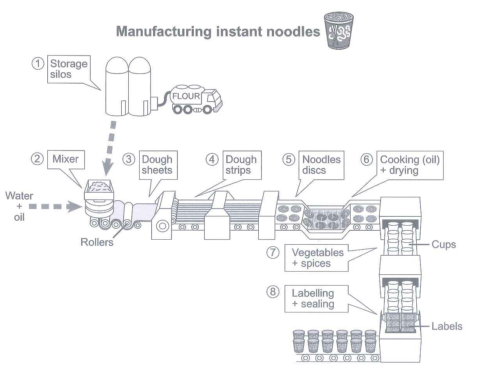
The diagram below shows how instant noodles are manufactured.
Summarize the information by selecting and reporting the main features and make comparisons where relevant.
Student answer (Band 6.5)
The diagram illustrates the process of manufacturing of noodles.
Overall, the process consists of eight steps, starting with taking flour from storage and silos and results in the labelling and sealing of instant noodles.
Initially, flour is taken from the storage and silos. Then, the flour is mixed with water and oil to make a soft dough. Following this, dough sheets are made after putting the dough in a rollers. In the next step, dough sheets are cut with the help of cutting machine and dough strips are made. After this, noodles discs are made with the help of machine. Subsequently, noodle disc are cooked in oil and dried to remove the extra moisture.
In the later stage, vegetables and spices are added to it to enhance the taste and to give flavour to the noodles. Finally, labelling and sealing of instant noodles is done and is transported for sale.
AI examiner evaluation
| Criterion | Band |
|---|---|
| Task Achievement / Task Response | 6.0 |
| Coherence and Cohesion | 7.0 |
| Lexical Resource | 6.0 |
| Grammatical Range and Accuracy | 6.0 |
| Overall | 6.5 |
Task Achievement / Task Response: Band 6.0
You describe the main sequence from flour storage through mixing, shaping, cooking and drying, then adding vegetables and spices. The overview also identifies the process as having eight steps and gives its broad beginning and end. However, some important details are incomplete or inaccurate: the diagram shows the finished noodles being placed into cups before labelling and sealing, whereas your account omits the cups and says the product is transported for sale, which is not shown. The opening phrase “taking flour from storage and silos” is also unclear about the silos’ role. To strengthen the report, describe the final packaging stages precisely and avoid adding an unsupported destination.
Coherence and Cohesion: Band 7.0
The response is organised into an introduction, an overview and two chronological body paragraphs, so the reader can follow the manufacturing sequence. Linking expressions such as “Initially,” “Following this,” “Subsequently” and “In the later stage” help signal progression. The division between the shaping/cooking stages and the later additions is also sensible. Some transitions are a little formulaic, and the final sentence combines labelling, sealing and transport without clearly showing the sequence or the cups stage. Use a wider range of linking methods, including references such as “At this point” or “The resulting cups,” and make each stage connect explicitly to the next.
Lexical Resource: Band 6.0
You use relevant process vocabulary, including “dough sheets,” “dough strips,” “noodles discs,” “cooked” and “dried,” which makes the stages generally clear. There is some useful variation in expressions such as “made,” “cut” and “added,” but several phrases are imprecise or repetitive: “with the help of machine” occurs twice, and “extra moisture” adds an interpretation not stated in the diagram. “Storage and silos” is also an awkward description of the flour’s starting point. Aim for more precise process verbs and natural collocations, such as “pass through rollers,” “are formed into strips” and “are placed in cups.” This would improve accuracy and flexibility without making the account unnecessarily elaborate.
Grammatical Range and Accuracy: Band 6.0
You use a mix of simple and more complex forms, including the passive construction “are added” and the time clause “after putting the dough in a rollers.” The sequence is usually understandable, but some grammatical errors remain. For example, “a rollers” has an article–number mismatch, “noodle disc are cooked” has a plural agreement error, and “labelling and sealing … is done and is transported” creates unclear agreement and reference. The opening “manufacturing of noodles” also needs a more natural grammatical construction. Practise consistent passive forms for process descriptions and check articles, plurals and the subject of each verb. These corrections would make the stages more precise while preserving your clear overall meaning.
See this exact question answered at other band scores. The same prompt compared across bands.
Browse more IELTS Writing model answers or get your own writing scored by the same AI examiner.