Band 5.5 IELTS Writing Task 1 Model Answer
Overall Band Score: 5.5 · Cambridge IELTS 15 · 2026-11-24
IELTS Writing Task 1 question
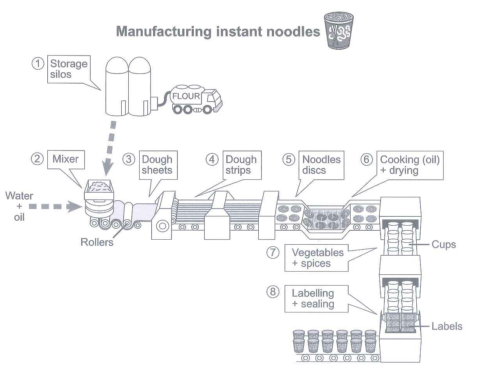
The diagram below shows how instant noodles are manufactured.
Summarize the information by selecting and reporting the main features and make comparisons where relevant.
Student answer (Band 5.5)
The step by step diagram shows the process of production of the instant noodles from raw material to the end packaged product.
Overall, the process of the production of the instant noodles take around eight steps from delivering the flour to the storage silos, shifting it to the mixer, making dough, creating noodles strips, cooking, adding additives and then packaging it to deliver.
The process start when the Flour is shiftted from truck to the storage silos. The flour is then transfered to mixer where water and oil is added in the flour and the three componenet mixture is mixed until it transforms into a soft and fluffy dough. The dough is then shifted to strips making machine through rollers and the strips are then transformed into noodles over the discs and move towards the cooking and drying stage over the discs, upon completion the noodles dics are added into the cups and the cups move towards the seasoning and additive parts where spices and vegetables are added into the cups. The cups then move towards sealing and labelling part where they are transformed into an end product, which is instant noodles.
AI examiner evaluation
| Criterion | Band |
|---|---|
| Task Achievement / Task Response | 6.0 |
| Coherence and Cohesion | 6.0 |
| Lexical Resource | 5.5 |
| Grammatical Range and Accuracy | 5.0 |
| Overall | 5.5 |
Task Achievement / Task Response: Band 6.0
You give a relevant account of the process from flour delivery through to the finished cups, and your overview identifies the main stages, including mixing, shaping, cooking and packaging. However, some details are inaccurate or unclear: the diagram shows dough becoming sheets and then strips before being formed into noodle discs, whereas “transformed into noodles over the discs” does not clearly describe this sequence. The cups are filled with vegetables and spices before labelling and sealing, but your account places the cups moving to the “seasoning and additive parts” after the cooking stage without clearly explaining how the noodles enter them. The overview also says the process takes “around eight steps,” which is not a duration. More precise reporting of the stages and their order would strengthen coverage.
Coherence and Cohesion: Band 6.0
The response has a clear overall structure: an introduction, an overview, and a chronological description. Sequencing expressions such as “Overall,” “The process start when,” and “The cups then move” help the reader follow the production line. However, the final paragraph is a very long sentence containing several stages, so the relationships between shaping, cooking, and cup filling become difficult to follow. Some linking is also mechanical, with repeated use of “then” and “the cups.” Divide the process description into shorter sentences and use clearer stage references, such as “After the strips are formed into discs…” This would make the progression more controlled and reduce ambiguity while preserving the generally coherent arrangement.
Lexical Resource: Band 5.5
You use a reasonable range of process vocabulary, including “raw material,” “storage silos,” “mixture,” “rollers,” and “packaged product,” which is appropriate to the diagram. However, several word choices or collocations are imprecise: “additives” and “seasoning and additive parts” are less accurate than naming the vegetables and spices, while “transformed into an end product” is unnecessarily vague. Spelling errors such as “shiftted,” “transfered,” “componenet,” and “dics” are noticeable and reduce the accuracy of the vocabulary. Aim for precise process verbs and check spelling carefully; for example, describe dough as being “rolled into sheets” and noodles as being “formed into discs.”
Grammatical Range and Accuracy: Band 5.0
You attempt both simple and more complex sentence forms, including a relative clause in “where water and oil is added” and a sequence joined with “where” and “which.” However, some grammatical errors recur. Subject–verb agreement is incorrect in “the process … take” and “The process start,” and passive forms need agreement in “water and oil is added” and “the flour is then transfered.” Articles and number are also inconsistent, as in “the three componenet mixture” and “the noodles dics.” The final sentence is overloaded with clauses, making grammatical relationships harder to control. Use shorter sentences and check each verb against its subject, especially in passive constructions.
See this exact question answered at other band scores. The same prompt compared across bands.
Browse more IELTS Writing model answers or get your own writing scored by the same AI examiner.