Band 5.0 IELTS Writing Task 1 Model Answer
Overall Band Score: 5.0 · Cambridge IELTS 15 · 2026-11-25
IELTS Writing Task 1 question
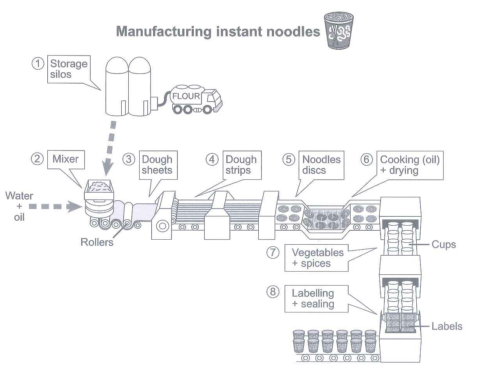
The diagram below shows how instant noodles are manufactured.
Summarize the information by selecting and reporting the main features and make comparisons where relevant.
Student answer (Band 5.0)
The process of making of instant noodles is discribe in the diagram below. The whole process take place in 8 steps. It start from the storage soil and then mixing it with water and oil then it goes uder the rollers after that dough strips process. more over afterr all of this it goes in noodles discs and then into cups and all the spices are added and then labelling and sealing.
First of all the process start when the flour is store in a storage silos and the it is goes in the process where the water and oil is mixed in the mixer after mixing that flour goes under the rollers and then on the dough sheets and then before going to noodles discs it goes into dough strips then it goes into the noodles discs.
After going there it is being cooked in oil and then it is also dry in the same step for preservation then it goes in the second last step called vegetables and spices it goes into cups and all the spices and veges are added in it after that it goes toward the labelling and the process of sealing.
AI examiner evaluation
| Criterion | Band |
|---|---|
| Task Achievement / Task Response | 4.5 |
| Coherence and Cohesion | 5.0 |
| Lexical Resource | 5.0 |
| Grammatical Range and Accuracy | 5.0 |
| Overall | 5.0 |
Task Achievement / Task Response: Band 4.5
You identify the general subject and report several stages, including mixing, shaping, cooking, adding ingredients, and sealing. However, the account is incomplete and sometimes misrepresents the sequence: the diagram shows eight numbered stages, but your overview says the process has eight steps while omitting the storage silos as a distinct stage and not clearly describing the rollers and dough sheets. The overview also suggests the noodles go “into cups” before the spices are added, whereas the diagram shows cups and vegetables/spices being added at the filling stage after cooking and drying. The final conveyor output is not mentioned. To improve, give a concise, accurate overview of the start and end points, then describe each main stage in order without merging or confusing steps.
Coherence and Cohesion: Band 5.0
There is some organisation: you begin with a general description, then use “First of all” and “After going there” to move through the process. The stages are mostly presented in the correct broad order, so the reader can follow the basic production sequence. However, progression is weakened by long, run-on sentences and repeated linking phrases such as “then,” “after that,” and “after going there.” The first paragraph also compresses many stages into one sequence, while the later paragraphs repeat some of the same information. Use clearer paragraphing for an overview and the process details, and connect each stage once with precise transitions such as “Next,” “Following this,” and “Finally.”
Lexical Resource: Band 5.0
You use some relevant process vocabulary, including “mixer,” “rollers,” “dough sheets,” “noodles discs,” and “labelling and sealing,” which helps communicate the topic. However, the range is limited and several inaccurate or informal choices make parts difficult to understand. “Storage soil” appears to be a mistaken label for “storage silos,” while “veges” is too informal for an IELTS report. There are also repeated spelling errors, including “discribe,” “uder,” and “afterr,” and awkward combinations such as “the process of making of instant noodles.” Aim for accurate technical terms and more precise verbs for each stage, rather than repeatedly using “goes.”
Grammatical Range and Accuracy: Band 5.0
You attempt to link stages in longer sentences, but these structures are often faulty, and many sentences contain errors that make the sequence harder to follow. For example, “The whole process take place” has subject–verb disagreement, and “It start from the storage soil” has an incorrect verb form and an unclear construction. In “the it is goes in the process,” the pronoun and verb pattern are not controlled; “it is also dry” should use a passive form such as “it is also dried.” Articles and plurals are also inconsistent, as in “a storage silos.” Practise writing shorter, complete sentences with consistent present-simple passive forms, for example, “The flour is stored in silos” and “The noodles are cooked and dried.”
See this exact question answered at other band scores. The same prompt compared across bands.
Browse more IELTS Writing model answers or get your own writing scored by the same AI examiner.