Band 5.5 IELTS Writing Task 1 Model Answer
Overall Band Score: 5.5 · Cambridge IELTS 15 · 2026-11-25
IELTS Writing Task 1 question
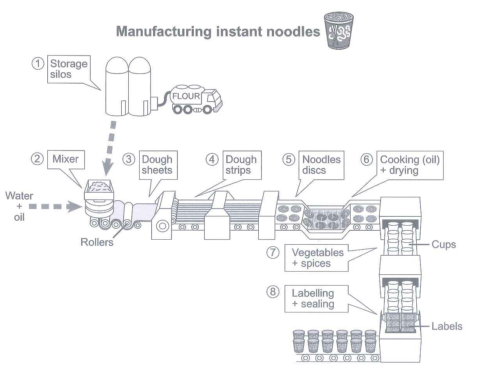
The diagram below shows how instant noodles are manufactured.
Summarize the information by selecting and reporting the main features and make comparisons where relevant.
Student answer (Band 5.5)
The diagram below illustrates how instant noodles are produced.
Overall, there are eight (8) stages invovled in the manufacturing of instant noodles, starting from storage silos to the last phase which is labelling + sealing.
In stage one, floor is been transfered from motor through pipe to a tank where it will be stored, then moved to mixer, where machine where water and oil will mix together. And then used rollers to move it to dough sheet, from Dough sheet to dough strips.
Furthermore, stage five (5) involved noodles discs and to cooking (oil) + drying, here oils is been cook and later used drying machine to dry it, which they were transfered to stage seven (7) where vegetables and spices are added inside cups before been moved to the final stage for labelling and sealling. Here, cups were sealed with covers, and then lebels them and later move out through wheel machine.
AI examiner evaluation
| Criterion | Band |
|---|---|
| Task Achievement / Task Response | 6.0 |
| Coherence and Cohesion | 6.0 |
| Lexical Resource | 5.5 |
| Grammatical Range and Accuracy | 5.0 |
| Overall | 5.5 |
Task Achievement / Task Response: Band 6.0
You identify the process as having eight stages and give a relevant start and end point, from the storage silos to labelling and sealing. You also include several key stages, such as mixing, forming dough sheets and strips, cooking and drying, and adding vegetables and spices. However, some details are inaccurate or unclear: flour comes from a truck through a pipe, not a motor, and the diagram does not show oil being cooked separately or a drying machine. The overview could also summarise the process more clearly as a sequence from flour storage through preparation and cooking to finished cups. Covering the intermediate stages and describing the final packaging more precisely would make the account more complete.
Coherence and Cohesion: Band 6.0
The response follows the general order of production, and the use of “Overall,” “In stage one,” and “Furthermore” helps signal a broad structure. The reader can trace the process from storage to packaging, so the organisation is coherent overall. However, the stages are compressed into long sentences, and some links between them are difficult to follow—for example, “And then used rollers to move it to dough sheet” does not clearly identify what is being moved or how the stages connect. The second body section also jumps from stage five to stage seven without clearly explaining the transition through cooking and drying. Use separate, logically grouped sentences for preparation, shaping, and packaging, with clear references to the product at each step.
Lexical Resource: Band 5.5
You use relevant process vocabulary, including “storage silos,” “mixer,” “rollers,” “dough strips,” “noodles discs,” and “labelling and sealing.” This gives the response an adequate range for describing the diagram. However, several word choices and collocations are inaccurate or awkward, such as “floor” for “flour,” “motor” for “truck,” “wheel machine,” and “oils is been cook.” Spelling errors such as “invovled,” “transfered,” “sealling,” and “lebels” also reduce precision. Aim for standard process verbs and accurate labels from the diagram, such as “is conveyed,” “is shaped,” and “is packaged.” More precise vocabulary would make the stages easier to understand without changing the overall structure.
Grammatical Range and Accuracy: Band 5.0
You attempt both simple and linked sentences, and the sequence is generally understandable. However, errors in verb forms, agreement, and sentence construction are frequent enough to make some parts difficult to read. For example, “floor is been transfered” needs a passive form such as “flour is transferred,” while “where machine where water and oil will mix together” contains a broken clause. The phrase “here oils is been cook” also has problems with agreement and passive construction. Several sentences begin with “And then” or “Furthermore” but lack a clear grammatical connection to the preceding clause. Practise forming consistent present-simple passive sentences for process descriptions, and check that each sentence has a clear subject and verb.
See this exact question answered at other band scores. The same prompt compared across bands.
Browse more IELTS Writing model answers or get your own writing scored by the same AI examiner.