Band 5.0 IELTS Writing Task 1 Model Answer
Overall Band Score: 5.0 · Cambridge IELTS 15 · 2026-11-25
IELTS Writing Task 1 question
The diagram below shows how instant noodles are manufactured.
Summarize the information by selecting and reporting the main features and make comparisons where relevant.
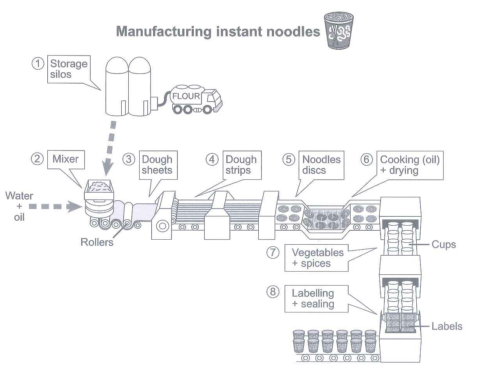
Student answer (Band 5.0)
The daigram show the process of manufacturing instant noodles.
Overall,it is a 8 steps process,starting from storing flour in silos and
ending with lablling and sealing the cups.
First, flour is stored in storage silos and then transported by a truck to the factory
then ,the flour is mixed with water and oil in a mixture to make the dough.then the dough was passed from the roller and into a dough sheets then cut into the strips and make noodles.
After all the things we do the then we fried into the noodles discs all the process were going with the machines then we dry oil from the strips and put the strips in a cup and put the falvours in it like vegetable and chicken and then we labling the tabs of prices and seal the cups from machine last we label the whole cup and come into market
AI examiner evaluation
| Criterion | Band |
|---|---|
| Task Achievement / Task Response | 5.5 |
| Coherence and Cohesion | 5.5 |
| Lexical Resource | 5.0 |
| Grammatical Range and Accuracy | 4.5 |
| Overall | 5.0 |
Task Achievement / Task Response: Band 5.5
You identify the process as manufacturing instant noodles and give a basic start-to-finish account, including flour, mixing, shaping, cooking, adding ingredients, and packaging. However, several details are inaccurate or unclear: the flour is delivered by truck to the silos, not transported from the silos to the factory; the diagram shows cooking in oil followed by drying, rather than frying and then removing oil; and it does not specify chicken, price labels, or the product going to market. The overview also calls this an eight-step process without clearly summarising the main stages. To strengthen the response, report the sequence precisely and distinguish the noodles’ processing from the later addition of vegetables and spices and the final sealing.
Coherence and Cohesion: Band 5.5
There is a recognisable overall structure: an opening and overview are followed by a description of the stages. The sequence is partly traceable through words such as “First,” “then,” and “After,” and the response generally follows the manufacturing process. However, most of the details are compressed into one long paragraph, with repeated or awkward transitions such as “then” and “after all the things.” This makes the progression difficult to follow, especially where shaping, cooking, drying, and cup filling are combined. Use separate paragraphs for the overview and process, then group the stages into clear phases and connect them with accurate sequencing phrases such as “Next,” “Following this,” and “Finally.”
Lexical Resource: Band 5.0
The response uses some relevant process vocabulary, including “storage silos,” “roller,” “dough,” “strips,” and “seal,” so the reader can identify the general subject. However, the range is limited and several word choices are inaccurate or imprecise: “mixture” is used where “mixer” is intended, “fried” does not accurately describe the diagram’s cooking stage, and “tabs of prices” does not match the labels shown. Spelling errors such as “daigram,” “lablling,” and “falvours” are noticeable and sometimes make the intended wording harder to recognise. Build a more precise set of process terms and check spelling, especially for key stages and ingredients.
Grammatical Range and Accuracy: Band 4.5
You attempt to connect several stages in longer sentences, but these structures are often faulty, and sentence boundaries are not controlled consistently. For example, “First, flour is stored in storage silos and then transported by a truck to the factory then” joins stages with no clear punctuation and reverses the process. Tense also shifts from “is stored” and “is mixed” to “was passed” and “we fried,” while subjects and verb forms are sometimes unclear. Commas and full stops are frequently missing, creating run-on sentences that make the sequence harder to understand. Practise writing one complete sentence for each group of stages, using consistent present simple passive forms, such as “The dough is rolled into sheets and cut into strips.”
See this exact question answered at other band scores. The same prompt compared across bands.
Browse more IELTS Writing model answers or get your own writing scored by the same AI examiner.