Band 6.0 IELTS Writing Task 1 Model Answer
Overall Band Score: 6.0 · Cambridge IELTS 15 · 2026-11-26
IELTS Writing Task 1 question
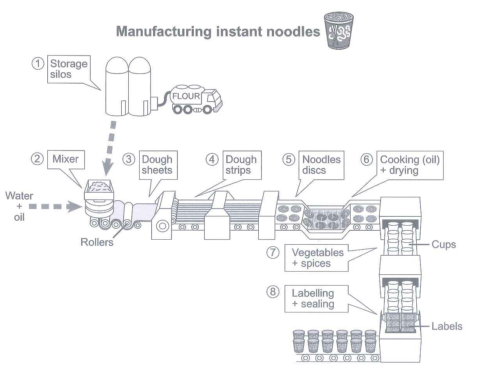
The diagram below shows how instant noodles are manufactured.
Summarize the information by selecting and reporting the main features and make comparisons where relevant.
Student answer (Band 6.0)
The given process chart shows the manufacturing process of an instant noodles.
Overall, this process contains 8 steps in total where a flour is being used as a raw material.
The process start with a flour which stored in the Storage silos transported to a processing plant via truck. Then water and oil is being added to a mixture with the flour and then process the product via rollers where it transforms into Dough sheets. Then after passing through a machine it results in Dough strips.
Then in step 5, that same Dough strips converted into Noodles discs after passing from another machine and then machine adds Cooking oil in it and dry to make it ready for the next step. After that noodles transferred to cups where we can see addition of some vegetables and spices in that. Then the next step contains the labelling to those cups which was being done by another machine and at the end they became ready to sell and transported to a storage.
AI examiner evaluation
| Criterion | Band |
|---|---|
| Task Achievement / Task Response | 6.0 |
| Coherence and Cohesion | 6.5 |
| Lexical Resource | 6.0 |
| Grammatical Range and Accuracy | 5.0 |
| Overall | 6.0 |
Task Achievement / Task Response: Band 6.0
You cover the main sequence from flour storage through mixing, shaping, cooking, adding ingredients, and packaging, and your overview identifies the process as having eight steps. Most stages are recognisable, but some details are incomplete or inaccurate: the flour is delivered by truck to the silos, rather than being described as already stored and then transported to the plant; the cups are filled with noodles as well as vegetables and spices; and the diagram shows finished cups emerging on a conveyor, not being transported to storage. The overview could also state more clearly that this is a linear, multi-stage manufacturing process. Develop the final packaging stage and report the diagram’s endpoint precisely to make the account more complete.
Coherence and Cohesion: Band 6.5
The response has a clear overall progression, moving from the raw material to the finished product, and the paragraph break separates the overview from the process details. Sequencing expressions such as “Then,” “After that,” and “at the end” help the reader follow the stages. This organisation is effective, though the repeated use of “Then” makes the links somewhat mechanical, and some references are unclear: “that same Dough strips” and “it” in “adds Cooking oil in it” require the reader to infer what is meant. Grouping related stages into clearer sentences and using precise references—for example, naming the noodle discs or cups—would make the progression smoother and more controlled.
Lexical Resource: Band 6.0
You use relevant process vocabulary, including “raw material,” “rollers,” “Dough sheets,” “Dough strips,” “Noodles discs,” and “labelling,” so the stages are generally understandable. There is also some useful variation in how you describe production, such as “transforms into” and “results in.” However, several word choices and collocations are awkward or imprecise: “process chart” is less suitable for a diagram, “a mixture” does not clearly name the mixer, and “ready to sell” is less precise than describing the cups as finished or packaged. Capitalisation of ordinary stage names is inconsistent. Aim for accurate process collocations and use the diagram’s labels consistently; this will improve precision without requiring more elaborate vocabulary.
Grammatical Range and Accuracy: Band 5.0
You attempt both simple and longer sentences, including sequences linked with “where,” “after,” and “then,” but control of sentence structure and verb forms is uneven. Examples include “The process start” instead of “The process starts,” “which stored” instead of “which is stored,” and “Dough strips converted” instead of “Dough strips are converted.” The sentence beginning “Then water and oil is being added” also has an agreement problem and shifts awkwardly between passive and active forms. Articles and plurals need attention in phrases such as “an instant noodles” and “a flour.” Practise forming consistent present-simple passive clauses for process descriptions, while checking subject–verb agreement and article use.
See this exact question answered at other band scores. The same prompt compared across bands.
Browse more IELTS Writing model answers or get your own writing scored by the same AI examiner.